Yacht watertight door control is the system that has to close a hole in a bulkhead and keep it closed while the boat is making way. Captains call when a WT door will not take a wheelhouse close, when the local on one side of the coaming works and the other side does not, when the pack is dead and the hand pump is a rumor, or when a surveyor asks what happens on power loss and the answer is a shrug. The leaf is steel. The control is what makes the opening part of the bulkhead again.
We design and build that panel. PLC, local stations both sides, remote close, the interlocks and alarms the watch actually runs. Fort Lauderdale and Newport, because that is where the boats already sit for other yard work. Custom yacht controls for build-outs and retrofits. Our team of electrical engineers can get it done.
What yacht watertight door control has to do at sea
A yacht WT door is a flooding boundary you can walk through. Class treats some openings as closed-at-sea, some as used but ready to shut, some as permanently shut with a log entry when they moved in port. Your control package has to know which door is which. If every leaf is just a door, the watch will treat a flooding boundary like a pantry swing. They will, until the first real list in a seaway.
At sea the job is easy to underspec. Local open and close from both sides of the bulkhead, including with a list on the boat. Remote close from the wheelhouse, and often from a second station above the bulkhead deck if fire or flood keeps you off the local levers. An audible at the leaf before and while the door travels on a remote command, so nobody walks into a sliding slab because the officer of the watch hit close-all. Manual means if the power pack is gone. A defined behavior when main power dies.
Commercial language talks about closing against a list, a close that is neither instantaneous nor a ten-minute crawl, and a wheelhouse that can shut more than one power door without sending a bosun below. Lloyd's, DNV, and Bureau Veritas ask in that same family of questions even when the ticket is a yacht notation rather than a passenger-ship certificate. We will not pretend a logo on a datasheet is your class certificate. Your job is a package that can answer those questions with a test.
Indication is a related problem, not this one. If the page and the coaming disagree, that is a truth problem we already wrote as when a yacht door control system starts lying to you. Read that if the mimic is the failure. This post is the door that has to actually be watertight: local, remote, interlocks, power loss, and the class conversation around flood integrity.
Local vs remote on a yacht WT door
Local is for the people walking through with stores or a toolbox. Both sides of the coaming. A lever or a hold-to-run that a gloved hand can find in the dark. If the boat is in an at-sea or doors-closed mode, local can open to pass, then the leaf recloses when you let go. Crew who have lived with a badly timed auto-reclose either tape the lever or they kill the mode. Time the reclose with a person in the opening, in the yard, not on a laptop in the shop.
Remote is for the person responsible for the vessel. Wheelhouse close. Sometimes ECR as a second view. Sometimes a station above the bulkhead deck that still works if the machinery space is the problem. Remote should close. It should not be a silent open from the helm while a steward is in the rebate. If your current package lets the bridge drive the leaf both ways with no local deadman and no audible, write that down before the next surveyor does.
Local control from both sides of the coaming has to stay independant of the wheelhouse close command, so a failed remote output cannot pin a leaf open, and a failed local cannot hide a remote close the officer already ordered. Caleb (Head Systems Engineer) will care whether those are actually separate circuits in the logic, not two coils that share a name. If the Beijer goes dark, the doors sit in a defined state. Ask that in the first meeting. Logic in the PLC. Display on the HMI.
Permissions are boring and they save people. Deck should close or pass a WT door without hunting guest graphics. Engineering should see travel timeout, low pack pressure, a limit that never arrived, a door left open in doors-closed mode. Interior should not have a tile that defeats a remote close. Ask where the second HMI lives if the boat runs from wheelhouse and ECR. Do not discover that on sea trial.
Sliding watertight door control against list and power loss
Sliding watertight door control is a different animal from a hinged WT leaf with dogs. The sliding door is a powered slab in a track. It has to close against a list, through a little debris, with a pack that still makes pressure at the end of the stroke. Hinged WT doors fail on dogs and cleats: a leaf sitting in the frame is not a made bulkhead. Sliding doors fail on track, accumulator, solenoid, and a close that looked fine in a flat marina and will not finish when the boat is heeled on a Fort Lauderdale wall.
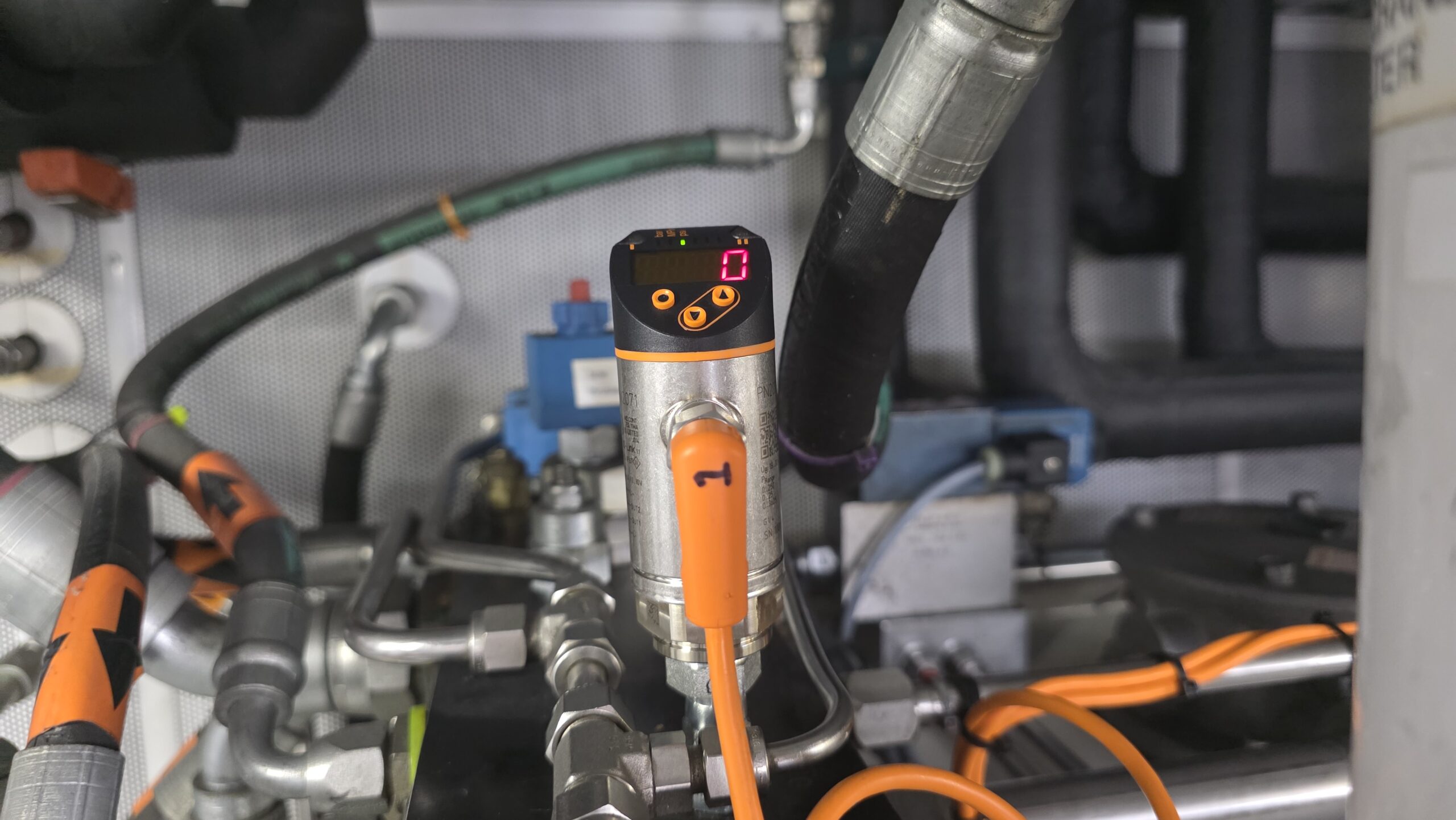
Limit switches and proximity sensors are how the PLC knows the opening is gone. Open. Closed. Traveling. If you only fitted a single cheap closed contact, you cannot prove the bulkhead. A proximity that sits a few millimeters off after paint will leave you in traveling forever, or it will declare closed early. IFM sensors earn their keep here because they are still buyable and they alarm into the PLC. Put open and closed on separate devices. Commission with a person at the coaming on the radio.
Power is where a lot of quotes get cute. Sliding WT doors want a supply that is not sharing a convenience board with a coffee machine. Emergency source, often a dedicated run from the emergency switchboard or a distribution board above the watertight limit. Transitional power so the watch can still see what the leaf did when main dies. Stored energy, if class expects a powered close after a blackout, is an accumulator you can test. Ask, in writing, what happens on main loss, on emergency, and on HMI failure. Stay put. Complete a close. Go limp. Those are three different boats. The watch has to know which one they have before the drill.
The hand pump is the piece everyone forgets. Seals dry. Handle missing. A locker that was painted shut. Put the manual means in the commissioning list. Stroke it. Log it. Same for local levers after a list test, even a modest one alongside. A sliding leaf that only closes on an even keel will not survive the conversation class is going to have with you.
Watertight door interlock with engines, alarms, and the watch
A watertight door interlock is the logic that keeps a flooding boundary from being treated like a door you prop with a crate. Doors-closed mode should raise a real alarm if a WT leaf that class treats as shut at sea is left open. The alarm belongs on the watch, in English, with a door name a bosun can walk to. A banner that lives only on an overview page will be ignored by the second night underway.
Some boats go further. A machinery-space WT door that is not made can inhibit a remote machinery function, hold ventilation the way the fire plan already expects, or block a start the engineer should not take with that bulkhead open. That is boat-specific. Do not let a vendor sell a universal engine-start inhibit as if every yacht ticket requires it, and do not let them skip the alarm because the last job did not have one. Ask what is actually interlocked on this vessel: which doors, which modes, which machinery, which alarm group. Then test it.
Travel interlocks are the ones crew feel every week. Do not call close if the safety edge or photocell is blocked, and do not jumper those sensors because they nuisance-trip in a stores alley. Fix the aiming. If the leaf stops on an obstruction, the HMI says so. Low hydraulic pressure should inhibit a close that will not finish, and it should alarm. Timeout should be a fault, not a green closed.
Do not bury a WT close inside an interior controller because the same coaming happens to carry a fire magnet. Watertight is flooding. Fire is a zone you meant to keep. A door can be both, and then the logic has to be both.
What a watertight door PLC has to prove for class
Lloyd's, DNV, and Bureau Veritas will not grade your render. They will ask what still closes on power loss, whether local still works when remote is dead, whether the log and the leaf agree, and whether a wheelhouse close is a real close with an audible at the opening. A watertight door PLC has to make those answers boring. WAGO in the panel because the next I/O slice is still in production. Beijer as the crew-facing glass: overview of open, closed, traveling, and doors-closed mode; an alarm list in English; one door page with commanded versus confirmed. IFM on the field devices that actually prove position and pack health.
Unsupported OEM door controllers show up here the same way they show up on every other ugly subsystem. Proprietary I/O. A board you cannot buy. If the leaf still seals and the track is true, you do not automatically need a new door. You need electronics you can still buy. Same control-only honesty we used on a 46m Trinity Yachts (2002) hydraulic plant: Koopnautic/Quantum aged out, tanks and valves stayed, WAGO PFC200 and Beijer X2 went in. That hydraulic control refit was not a door job. The rule still applies. Keep sound mechanicals. Replace the part you cannot support. We are not going to invent a WT-door nameplate or a fake class ticket to make the point twice.
Adam (Electrical Engineer) will care about the enclosure: cage clamp, labeled landings, a drawing that matches the wire, spare I/O so the next hatch does not require a new CPU. Proof for class is also a documentation pack. I/O list with terminal numbers. Which doors are closed-at-sea. Power-loss behavior per door. Interlock list. A short crew note, not a forty-page PDF.
Marine watertight door automation in a Fort Lauderdale or Newport window
Marine watertight door automation fits a yard period you already have when the scope stays control-only. Panels can be built off the boat in the Fort Lauderdale shop, or in Newport when that is the season you actually get. Field devices cannot be commissioned from a drawing. Kyle (Operations) will tell you whether this sits next to paint or whether someone is about to sell you a mechanical door replacement you did not ask for. Plan as if other trades will lift a limit switch the night before sea trial. Newport in season has less calendar to absorb that.
Commissioning is function-based, per door. Local both sides. Remote close from the wheelhouse, with the audible live. At-sea mode: open to pass, confirm the reclose. Obstruction in the track, in the yard, on purpose. Power-loss: kill the main, watch what the leaf does, watch what still indicates. Manual pump. List, even a modest one, if the boat can give it to you alongside. If a surveyor is in the picture, this is when you generate the evidence.
Bring a short list to the meeting. You do not need to become a programmer. You do need answers a chief can live with after the yard leaves.
- Which WT doors are in scope, by space, and which are closed-at-sea versus used-and-ready
- Local both sides, remote close, secondary station if required, audible at the leaf
- Open, closed, and traveling from real limits or proximity, dogs or cleats if the leaf uses them
- Power: main, emergency, stored energy, and what the door does when each one dies
- Watertight door interlocks: doors-closed alarms, machinery inhibits that actually exist on this boat, travel and pressure inhibits
- Spare CPU, spare HMI, spare I/O, whether those parts are still manufactured, and where they sit
- Drawings, I/O list, and a crew note the next technician can use without a login
If you want that conversation, start with Yacht Automations out of Fort Lauderdale or Newport and send the door schedule plus whatever electrical drawings still exist. Even a faded I/O list beats a walkthrough guess. A note to kyle@yachtautomations.com with the spaces and the class society is enough to start. The watch needs yacht watertight door control that actually holds the bulkhead, a PLC that still has a spare, and a yard window that does not become the season.