The call usually starts the same way. A windlass that will not start on the first try. A tender crane that faults mid-lift. Or a stabilizer page that goes blank while you are still in a seaway. The mechanical side still looks fine. Tanks, pumps, valves, actuators. All of it. The electronics behind them are the problem. On a 46-meter Trinity Yachts motor yacht from 2002, that electronics package was a Koopnautic (Quantum) hydraulic control system that had simply aged out of support.
This is the case study of that hydraulic control refit. Not a full system rip-out. A control-only upgrade: WAGO PFC200, Beijer X2 HMI, IFM sensors, and a rewired enclosure on WAGO cage clamp terminals. The mechanical plant stayed. Captains care about three things in a job like this: how long the boat is dead in the water, whether the next failed part can be bought without a scavenger hunt, and what the crew actually sees on the screen when something goes wrong at 0200.
What happens when yacht hydraulic controls go obsolete
Koopnautic / Quantum was a common stack on yachts of that generation. It ran the things you actually use every week: forward and aft anchor windlasses, the tender crane, bow and stern thrusters, stabilizer fin actuators, plus deck gear and hatches tied into the same hydraulic plant. When the electronics are current, nobody thinks about it. When they are not, every fault becomes a parts problem before it is even a troubleshooting problem.
Obsolete in this context is not a marketing word. It means the boards, the operator panel, and the proprietary I/O are no longer supported and no longer sitting on a shelf. You can still find a specialist who remembers the platform. You cannot count on them being in Fort Lauderdale the week you need them, and you cannot count on a substitute card arriving before the charter party does. The yacht sits. Or you run a workaround that nobody wants to explain to the next watch.
Crew feel it before management does. Intermittent faults. A page that redraws slowly. A beep you cannot clear. A pump that starts, then dumps to standby for no reason the log can explain. You start carrying a mental list of which functions you trust and which you do not. That is a bad way to run a hydraulic plant. Hydraulics do heavy, irreversible things. Windlass, crane, thruster, fins. You want the control side to be boring.
The Trinity still had good iron. That is the other half of the story, and it is the half a lot of yards miss. If the tanks are clean, the pumps still make pressure, and the valves stroke, you do not need a new hydraulic room. You need a control system that can talk to what is already there and that you can still buy in five years.
Can you keep the tanks, pumps, and valves on a hydraulic refit
Yes. That was the whole point of this job. Keep the mechanical equipment. Replace the electronics. It sounds obvious written down. It is not how a lot of refit quotes are structured. A full plant replacement is easier to spec from a catalog. It is also a longer yard period, more pipework, more class conversation than you may need, and a bigger hole in the operational calendar.
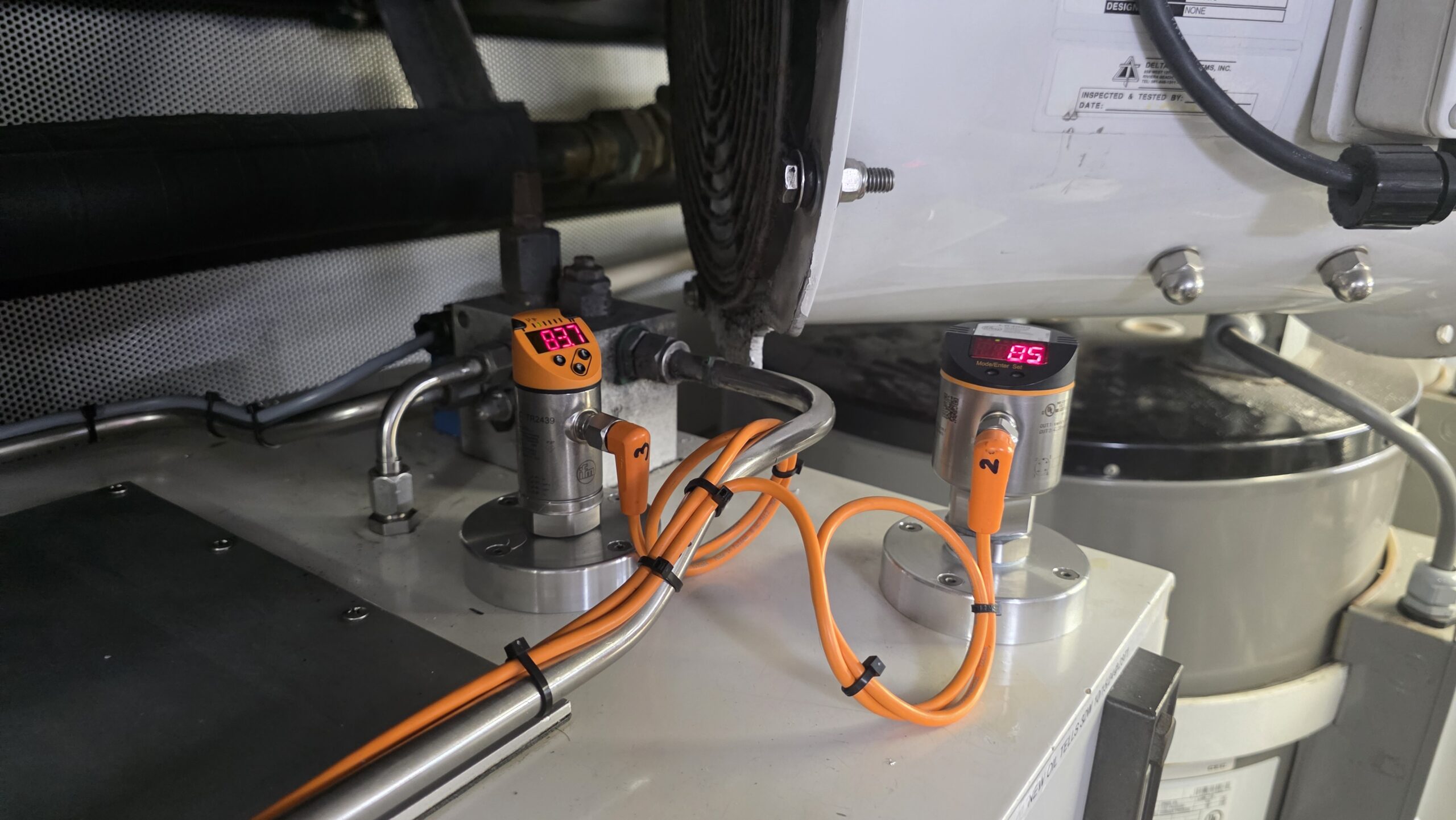
What we kept: tanks, pumps, valve assemblies. The mechanical side had been looked after. No reason to throw it away because the controller aged out. What we replaced: the obsolete Koopnautic electronics, the field terminations that had been patched over two decades, and the sensors that had drifted into the “maybe that’s right” category. New IFM sensors for fluid level, system pressure, and oil temperature. Digital, stable, and actually alarming into the PLC instead of sitting on a gauge nobody glances at until the oil is already dark.
Caleb (Head Systems Engineer) owns the control architecture on jobs like this. Adam (Electrical Engineer) owns the enclosure, the terminations, and the field wiring. Kyle (Operations) keeps the yard window honest. That split matters more than it sounds. A hydraulic control refit fails in two common ways: the software does not match how the boat actually sequences, or the panel is a rat’s nest that the next technician cannot touch. We try not to do either.
If you are evaluating a similar quote, ask the yard or the integrator a blunt question: which mechanical items are being condemned because they are worn, and which are being condemned because the vendor would rather sell a package? On this Trinity, the answer was clear. Electronics out. Mechanicals stay.
What a yacht hydraulic control refit actually changes
The new stack was industrial hardware with a marine track record, not a one-off yacht-only black box. WAGO PFC200 as the PLC. Modular I/O, so you are not trapped if a later refit adds a function. The PFC200 runs pressure management, sequencing, and the safety interlocks. Beijer X2 as the HMI, a 10-inch color touchscreen, one place for the crew to run and diagnose the plant. Field wiring landed on new WAGO cage clamp terminal blocks, labeled, documented, so the next person in the panel is not guessing.
That last point is not cosmetics. Cage clamp terminations hold up better in a vibrating engine-room world than a lot of the screw terminals they replace. And when a conductor does need to come off, it comes off without taking the neighboring landing with it. Adam will recieve fewer 2 a.m. calls about a mystery open if the panel is built that way. (That is the point of a rewire, not a prettier door sticker.)
Software was written for this vessel’s hydraulic layout, not copied from a generic template and hoped for. Original operating logic where it still made sense. Added alarm and diagnostic behavior where the old system was mute. The PLC sees the IFM data continuously: level, pressure, temperature. Low oil and high temp should be a crew problem on the HMI, not a seized pump three hours later.
Functions on the same plant, same as before: windlasses, tender crane, thrusters, stabilizer fins, associated deck equipment. The crew should not have to relearn how the boat works. They should get a screen that tells them the truth when the boat is not working.
What we actually put in the enclosure
- WAGO PFC200 handling hydraulic pressure, sequencing, and interlocks
- Beijer X2 10-inch HMI for control, status, and alarm acknowledge
- IFM sensors for level, pressure, and oil temperature, wired into the PLC
- Full re-termination on WAGO cage clamp blocks, labeled, with a documentation pack
How long is the yacht down for a control-only hydraulic refit
Control-only is the reason this job fits a scheduled yard period instead of becoming the yard period. You are not draining the world, pulling pumps, and waiting on fabricated tanks. You are pulling the obsolete electronics, landing new I/O, installing the HMI, and commissioning function by function. Other trades can keep working. That is the practical difference between “modernize the hydraulics” and “replace the hydraulics.”
We still do the unglamorous front end. Schematics. I/O list. Software spec. If that package is thin, you pay for it in the engine room with a laptop and a lot of opinions. On this Trinity the design work happened before the panel came apart. Then install. Then test: each hydraulic function on its own, then in combination, the way you actually use the boat. Windlass while a thruster is loaded. Crane through its travel with the interlocks live. Fins. You want the surprises in the yard, not on the first Med mooring of the season.
Fort Lauderdale is where a lot of this kind of work lands for us, because that is where the boats already are for other refit items. Newport the same, in season. A control refit is easier to slot when the vessel is already alongside for paint, interior, or a survey window. If someone is selling you a six-month hydraulic replacement and your mechanicals are sound, ask why the electronics cannot be the scope.
Documentation is part of the downtime math. A complete package (schematics, bill of materials with real supplier names, operating notes) means the next fault does not start with “who built this.” Crew should be able to walk a tech to the HMI, pull the alarm, and point at a labeled terminal. That is how you get back underway, not a nicer binder.
What does the crew see on the new hydraulic HMI
This is the part most spec sheets skip. Captains do not buy PLCs. Crew live on the HMI. If the screen is a mimic of the programmer’s memory map, people will stop using it and go back to the bypass. Then you have an expensive panel and the same operational risk you started with.
On the Beijer X2, the crew get a single place to run the hydraulic functions they already know, watch pressures and temperatures that used to live on scattered gauges, and acknowledge alarms that actually say what is wrong. Not a hex code. A description, a priority, and enough context to decide whether this is a stop-the-job fault or a watch-it fault. Low level. High temperature. A sequence that did not complete. The kind of language a bosun can act on without calling the engineer out of a tank.
Diagnostics matter more than pretty graphics. Which pump is called. Whether a valve commanded and whether it confirmed. What the last alarm was, and whether it is still active. If you cannot answer those from the wheelhouse or the local panel in under a minute, the HMI is decoration. We treat the X2 as a working tool. Same expectation we have for the rest of the PLC and HMI work on a yacht: one login path, labeled pages, no hidden engineer-only screens that the night watch cannot reach.
Training is short if the pages are honest. Walk the crew through the main hydraulic overview, the alarm list, and the one or two equipment pages they will actually open (windlass, crane, fins). Twenty minutes, not a binder. If a page needs a speech to explain it, the page is wrong.
How do you source parts after a Koopnautic system dies
You don’t, not reliably, and that is why the refit exists. After the upgrade, the spares conversation changes. WAGO PFC200 hardware, Beijer X2 panels, IFM sensors, cage clamp terminals. These are current-production industrial parts. They show up in marine work because they survive it, but they are not trapped inside a single yacht-vendor warehouse. That is the practical definition of future-proof on a 2002 Trinity: you can still buy the next CPU or the next HMI without waiting on a company that stopped making the old one.
Class still cares. Alarm and monitoring on a hydraulic plant is not a toy. Lloyd’s, DNV, Bureau Veritas each have their own flavor of what they want to see, but none of them are impressed by an unsupported controller and a handwritten bypass list. A modern PLC with logged alarms, sensor feedback, and a documented I/O list is a much easier conversation at survey than a dead Quantum panel with a “temporary” jumper that has been there for two seasons.
We work around vessels in the 40 to 165 meter range, and around yards that include Trinity, Lurssen, Oceanco, and Palmer Johnson. The pattern repeats. Good mechanicals, dead electronics, a captain who is tired of explaining delays. The Trinity 46m is the clean example because the scope stayed honest: hydraulics for windlasses, crane, thrusters, fins. Control system replaced. Plant retained.
What to ask before you sign a hydraulic control refit
Bring a short list to the meeting. You do not need to become a PLC programmer. You do need answers a chief can live with.
- Which mechanical items are staying, and who inspected them
- Exactly which electronic assemblies are coming out (controller, HMI, I/O, sensors)
- What the crew will see on the HMI for windlass, crane, thrusters, and fins
- How alarms are prioritized, and whether they log
- Spare parts: manufacturer, lead time, and whether the CPU is still in production
- Who commissions onboard, and who the crew calls after the yard period
If you want the same conversation we had on the Trinity, start with Yacht Automations out of Fort Lauderdale or Newport and send the existing hydraulic drawings if you have them. Even a faded I/O list beats a guess. We would rather tell you the mechanicals should stay than sell you a room full of new steel you do not need.
Obsolete yacht hydraulics are usually an electronics problem wearing a mechanical costume. On this 46m Trinity, treating it that way got the windlasses, crane, thrusters, and fins back on a platform the crew can run, the engineer can diagnose, and the next surveyor can actually read. That is the job.