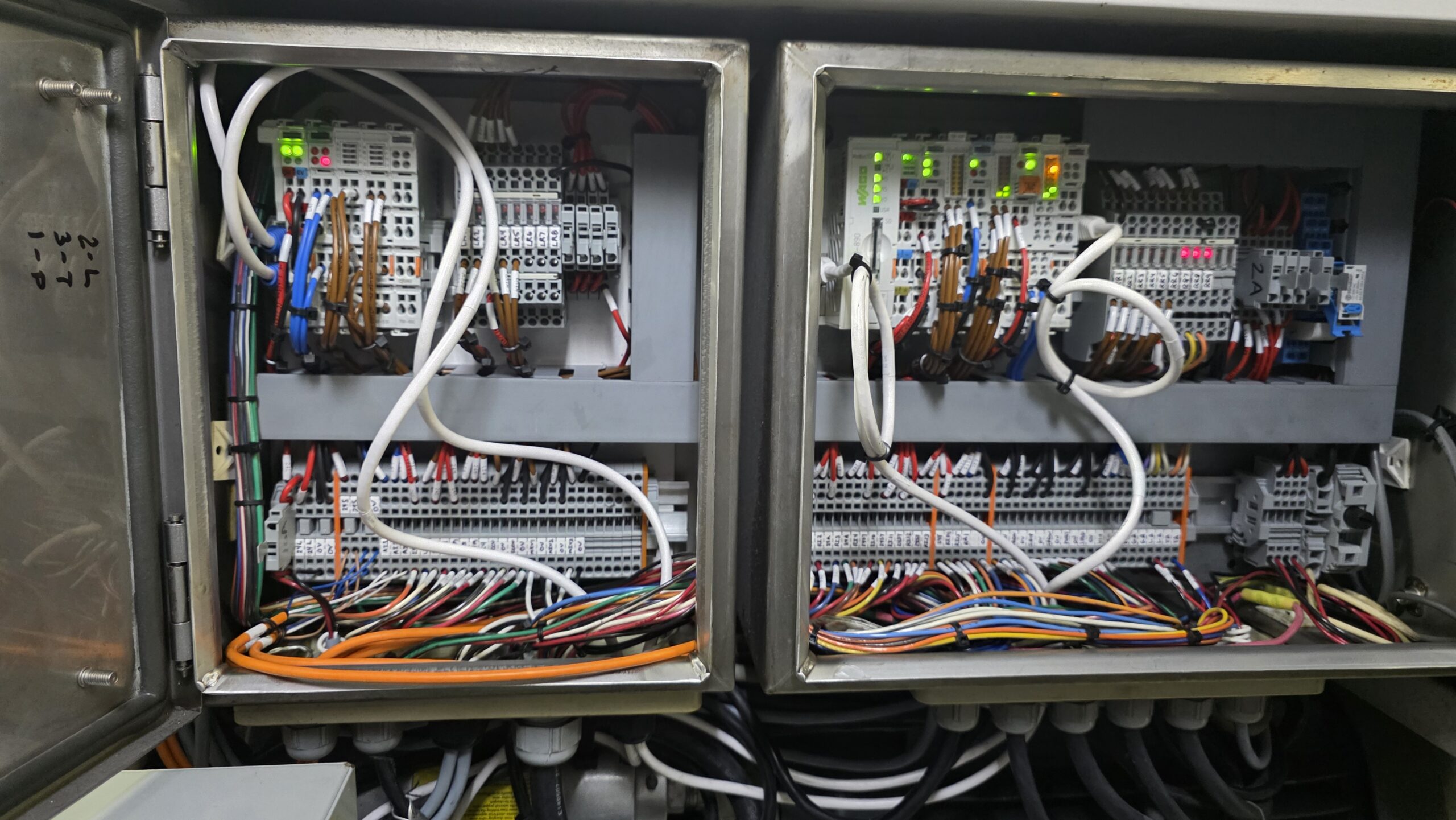
A yacht door control system fails quietly before it fails loudly. The leaf still looks like a door. The track is still there. What dies is the part the watch actually uses: indication, remote close, the interlock that says this opening is made. Captains call when a watertight door shows closed and a bosun can still walk through it, or when fire-zone doors stay latched open after a drill because the hold-open circuit never dropped. That is a control problem wearing a steel costume.
We design and build the panel around those doors. PLC, local stations, bridge or ECR indication, the automation that ties them together. Fort Lauderdale and Newport, because that is where the boats already are. Skip the pretty-mimic conversation. Demand a package that still tells the truth when the next surveyor, or the next night watch, is the one looking.
How a yacht door control system actually fails
Most of the time the steel is not the story. Limit switches drift. A proximity sensor sits a few millimeters off after a season of working the door against a slightly tired track. A dog that never quite seats still trips a cheap closed contact because the contact was wired as leaf-in-frame, not dogs-home. The bridge mimic is happy. The space is not.
Sliding watertight doors have their own flavor. Track debris. An accumulator that still holds some pressure but not enough to close against a list. A solenoid that sticks once a week and then behaves for the surveyor. Rotary limit boxes that fog internally and start reporting last Tuesday's state. Crew begin carrying a mental list: this door we trust, that one we walk and log by hand. Bad habit. Watertight integrity is not a rumor you manage with a flashlight.
Hinged doors fail smaller and then all at once. Reed switches that shifted after paint. A magnet that lost a screw. Cable glands in the coaming that wicked salt into a junction box nobody has opened since the last crew change. You get intermittent closed. Then you get a permanent closed that is wrong. Then someone wedges the leaf for stores and the page never notices.
Fire doors fail differently. Hold-open magnets that never release. A panel that used to talk to the fire system and now needs a jumper nobody wants to explain at handover. Sliding fire leaves that time out mid-travel and report closed because the last known state was optimistic. You find it on a drill. Or you find it later, which is worse.
Obsolete yacht door electronics sit under all of that. Proprietary I/O. A mimic with no spare lamps. A CPU that a specialist in Europe might still talk about if they are not already on a boat in Palma. Same shape of failure as the hydraulic stack on a 46m Trinity hydraulic control refit: good mechanicals, dead brain, parts you cannot buy. Doors are just more people-shaped. You do not get to wait for a spare board when the night watch is logging openings in a notebook.
What watertight door control has to show the watch
Indication the watch can trust is the whole job. Not a pretty GA mimic. Open, closed, and the ugly middle. Class language is consistent even when the societies are not identical. Red for fully open. Green for fully closed. Flashing red while the leaf is traveling if you closed it from the remote station. If your screen only has two states, it is lying about the third.
Ask whether the indicating circuit is independent of the control circuit. If a failed output can still paint a green lamp, you have decoration. Local indicators on both sides of the bulkhead, plus the bridge or machinery-control mimic. Dogs and cleats, if the door uses them, belong in the closed story. Leaf in the rebate is not the same as made. A surveyor who cares will ask. A chief who has been flooded by a "closed" door already knows.
Remote close from the bridge is not a party trick. There should be an audible at the door, and usually a visual, before and while the leaf moves. Local control from both sides still has to work, including with a list on the boat, including by hand if the power pack is dead. The manual pump is the piece everyone forgets until the drill. Seals dry. Handle missing. Ninety seconds that turns into five minutes of swearing. Put the hand pump in the commissioning list, not in a footnote.
In an at-sea or doors-closed mode the usual pattern is local can open to pass, then the door recloses when you let go. Crew who have lived with a badly timed auto-reclose either tape over the local lever or they disable the mode. Both are findings waiting for a name. A local red lamp that says the door is in remote close mode is not optional decoration. People walk through these openings with stores in their hands.
Power matters more than people admit on a quote. Sliding watertight doors want a supply that is not sharing a convenience board. Emergency source, often a dedicated run from the emergency switchboard or a distribution board above the watertight limit. Transitional power for indication so the mimic does not go blank in the one moment you need it. If the integrator shrugs at that sentence, they are building a convenience door. We will not pretend a logo on a datasheet is your class certificate. Lloyd's, DNV, Bureau Veritas each ask in their own voice. Your job is a package that can answer: what happens on power loss, what still indicates, what still closes, and whether the log matches the leaf.
Yacht fire door automation without mixing the jobs
Watertight is flooding. Fire is smoke, heat, and a zone you meant to keep. A door can be both, and then the logic has to be both, which is where a generic door page gets people hurt. Yacht fire door automation is hold-open and release, self-close, and a status the watch can read as held, closed, or failed to close. Do not bury a fire-release output in an interior controller because the magnet was "just a door."
Sliding fire doors on yachts (A-class leaves, big openings, the ones that look like interior until they are not) need travel feedback the same as WT sliding doors. Safety edges and photocells that nuisance-trip will train the crew to override them. Then you have a door that will not protect the zone when you need it. If the leaf stops on an obstruction, the HMI should say so in English. A silent retry loop is how you teach people to ignore the page.
Hinged fire doors are simpler until the closer is tired and the hold-open is the only thing keeping the space usable. Then you have a door that is normally open in practice and normally closed on the fire plan. Write that down. Program that. Do not hope. Engineering should see the fault: magnet still energized after release, travel timeout, mismatch between commanded and confirmed. Interior should not have a guest-facing tile that can defeat a release. The watch should see fire-zone doors as a group and a single door as a door. Those are different pages on purpose.
Local versus bridge on a yacht door control system
A package that only lives on a touchscreen is one cracked glass away from a problem. Logic in the PLC. Display on the HMI. If the Beijer goes dark, the doors should sit in a defined state, not a random one. Captains should ask that in the first meeting. Same question we push on any yacht PLC and HMI refit: if the screen fails, what still runs, and what is locked out on purpose.
Local stations at the door are for the people walking through. Bridge or ECR is for the people responsible for the vessel. Mixing those without a master mode is how you get a door hunting while a steward is in the opening. Secondary close from a station above the bulkhead deck belongs in the flooding-and-fire plan. Treat it that way in the spec. If your current package has a wheelhouse mimic and nothing else, write that down before the next surveyor does.
Permissions matter in the same boring way they matter on hydraulics. Deck should not hunt through unrelated graphics to close a WT door. The engineer should not need a guest-system login to see a fire door fault. One hardware family can still be several views. Ask for the split in the spec, not as a favor after commissioning. And ask where the second HMI lives if the boat actually runs from two places. Wheelhouse and ECR. Sometimes a local panel in a fire zone that the crew already uses. Do not discover that on sea trial.
Obsolete yacht door electronics: keep the leaf, replace the brain
If the door still seals, the track is true, and the actuator still strokes, you do not automatically need a new door. You need electronics you can still buy. That is the conversation we already had on hydraulics with a 2002 Trinity: Koopnautic/Quantum aged out, tanks and valves stayed, WAGO PFC200 and Beijer X2 went in. Doors rhyme with that. We are not going to invent a door nameplate or a fake yard story. The failure is common enough without one.
What usually comes out: the OEM controller, the tired mimic, the field terminations that have been stabbed and restabbed, sensors that report maybe. What should go in: a PLC still in production, modular I/O so the next hatch does not require a new CPU, an HMI the night watch can actually read, position and pressure feedback that alarms instead of sitting on a gauge nobody glances at. We use WAGO, Beijer, and IFM for that reason. Industrial parts with a marine track record. Not a sealed yacht-only box whose last spare lives in a drawer in another time zone.
Adam (Electrical Engineer) will care about the enclosure. Cage clamp, labeled, a drawing that matches the wire. Caleb (Head Systems Engineer) will care whether local, remote, and indication are actually separate circuits in the logic, not three coils that happen to share a name. Kyle (Operations) will care whether this fits the Fort Lauderdale window you already booked for paint, or the shorter Newport season you cannot slide. Those are the real constraints. Pretty door graphics are not.
The track and the seals still need ordinary maintence. Hydraulic packs still need oil that is not black. Safety edges still need to be wiped. None of that is an excuse to keep a dead controller because the door works if you kick the local lever. That sentence is how you get a finding, a flood log you cannot defend, or a fire drill that turns into a walk-through of spaces the page said were shut.
What to demand from a PLC and HMI door package
Bring a short list. You do not need to become a programmer. You do need answers a chief can live with after the yard leaves.
- Which doors are in scope, by space and by type (watertight, fire, sliding, hinged, weathertight), and which mechanical items are staying because they are sound
- Open, closed, and traveling indication, and whether dogs or cleats are part of closed
- Local both sides, remote close, audible at the leaf, and what at-sea mode actually does after a local open
- What happens on main power loss, emergency power, and HMI failure, including whether indication survives
- Alarm list in English a bosun can act on: travel timeout, mismatch, low hydraulic pressure, loss of indication, fire-release that did not confirm
- Spare CPU, spare HMI, spare I/O slice, whether those parts are still manufactured, and where they sit (boat, Fort Lauderdale shop, vendor)
- Drawings, I/O list with terminal numbers that match the wire labels, and a page index the next technician can use
Commissioning is function-based. Each door. Each local. Each remote. Combinations you actually use, because a yacht is not a lab bench. Close from the bridge with a pad in the opening, in the yard, and see whether the obstruction behavior is real. Fire-release with the hold-opens live. Indication versus a person standing at the leaf calling states on the radio. If a surveyor is in the picture, this is when you generate the evidence. Do not wait until they are on the passerelle asking why the mimic and the coaming disagree.
Fort Lauderdale yards will try to parallel this with other trades. Fine, if nobody is painting the leaf, temporarily lifting a limit switch, or cutting a feedback pair the night before sea trial. Newport in season has the same problem and less calendar. A control-only door job can sit inside a yard period you already have. A mechanical door replacement cannot. Do not let a quote mix them without saying so. Panels can be built off the boat. Field devices cannot be commissioned in a shop drawing.
If you want the same conversation we have on other ugly subsystems, start with the door schedule and whatever electrical drawings still exist. Even a faded I/O list beats a walkthrough guess. We would rather tell you the OEM panel can wait than rip out a system that is still supportable. The watch needs a yacht door control system that tells the truth, a PLC that still has a spare, and a yard window that does not become the season.