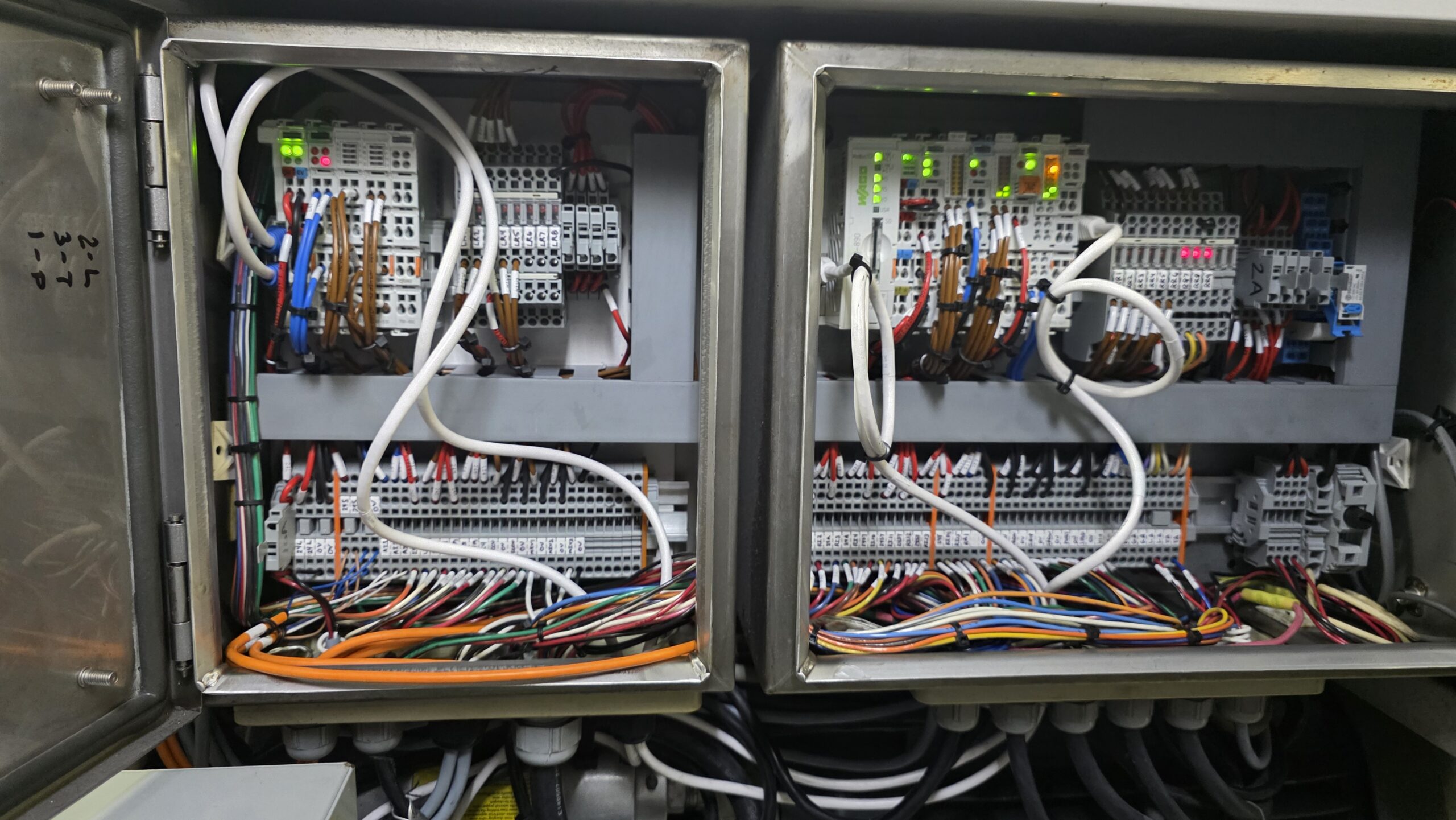
If you are a captain evaluating a control refit, skip the word “advanced.” Ask what the crew will press, what the engineer will diagnose, and whether the spare CPU is still in production. On a yacht, the PLC and the HMI (the screen in front of the watch) are the difference between a plant you can run and a plant you have to apologize for. This is a practical look at that stack, with WAGO and Beijer as the hardware we actually install, not a tour of luxury features.
We get this job when an OEM panel is obsolete, when three vendors have each left a controller behind, or when the owner wants lighting, climate, and monitoring on something the crew will still understand after a crew change. Fort Lauderdale and Newport are where those conversations usually start for us, because that is where the boats are already open.
What does a yacht PLC actually do for the crew
When the crane refuses to start, the PLC is usually the thing that decided that. Sensors, switches, valve feedback come in. Pumps, contactors, coils, interlocks go out. In between is the sequence you actually want: do not start the crane unless the conditions are met, do not call a second pump if the first is already making pressure, do not leave a watertight door showing closed if the switch never confirmed. The HMI is how a human sees that and, where it is safe, commands it.
That split matters. If the logic lives only in a touchscreen, you have a pretty boat until the screen dies. If the logic lives in the PLC, the plant can still sit in a safe state when the glass is dark. Captains should ask that question in the first meeting: if the HMI fails, what still runs, and what is locked out on purpose.
On yachts in the 40 to 165 meter range the PLC is usually covering a mix of auxiliaries rather than the main engines. Hydraulics (windlass, crane, thrusters, stabilizer fins). Doors and hatches. Passerelle. Lighting and load logic. HVAC enable and monitoring. Alarm concentration. Sometimes all of it. Sometimes one ugly subsystem that is holding the boat in the yard. Either way, the crew does not care that it is “programmable.” They care that the sequence matches how the boat is actually used, including the stupid local habits that never made it into the original functional design spec.
We have seen plants from Trinity, Lurssen, Oceanco, and Palmer Johnson jobs where the mechanicals were fine and the controller was the liability. The 46m Trinity hydraulic refit is the clean version of that: Koopnautic / Quantum electronics obsolete, tanks and pumps and valves kept, WAGO PFC200 and Beijer X2 put in as the new brain and the new face. If you want the long form of that job, it is in the hydraulic control system refit write-up.
WAGO vs a black-box OEM panel: what captains should ask
WAGO, specifically the PFC200 line we use, is modular industrial control. You land I/O in slices. You expand later without throwing the CPU away. The programming environment is something a competent marine controls person can support, not a sealed laptop image from a vendor who has since been bought. Cage clamp terminations, which is what we rewire panels onto, hold up in vibration and they come off without a fight. That sounds like electrician talk. It is captain talk the first time you need a conductor lifted during a charter week.
A black-box OEM panel can be excellent the day it is commissioned. Ten or fifteen years later it is a parts problem. No I/O map you can read. No spare CPU. A specialist who might receive your call if they are not already on a boat in Palma. The failure often occured slowly: a page that lagged, then a card you could not replace. That is the Koopnautic story, and it is not unique to hydraulics. Lighting controllers, climate interfaces, passerelle brains. Same shape of failure.
Questions that actually help:
- Is the CPU still manufactured, and who sells it in the US
- Can a second technician open the project file, or is it locked to one person
- Is the I/O list in the documentation pack, with terminal numbers that match the wire labels
- What happens if we add a function next refit (another hatch, another pump, another alarm group)
- Are the critical interlocks in the PLC, or only in the screen
If the answers are vague, you are buying a future yard period. Modular WAGO I/O is not magic. It is just how you avoid that. Same reason we like industrial hydraulics names (Wandfluh, Continental Hydraulics) when the valves themselves are in play: you can still buy the next one.
How to evaluate a Beijer HMI before you sign the yacht refit
Beijer X2 is the crew-facing piece we spec. Color touchscreen. Pages you can actually design for a watch, not for a trade-show booth. The 10-inch X2 on the Trinity hydraulic job is a useful mental picture: one place to run functions, see pressures and temperatures, and acknowledge alarms that are written in English a bosun can use.
Do not evaluate an HMI by how marine the wallpaper looks. Sit in front of it and try to do the job. Start the windlass page. Find the last alarm. Tell whether a valve was commanded and whether it confirmed. Change a setpoint you are allowed to change, and fail to change one you are not. If you need the programmer standing behind you, the page set is wrong. If every function is buried under a unique icon with no text, the night watch will guess, and guessing on hydraulics is how people get hurt.
Permissions matter. Interior should not have the crane. Deck should not have to hunt through HVAC graphics to set working lights. Engineering should have the analog values and the alarm history without flipping through guest scenes. One hardware family can still be several views. Captains should ask for that split in the spec, not as a favor after commissioning.
Also ask how the HMI is backed up. Project file, panel image, spare unit. A smashed screen during a Med season should be a courier problem, not a redesign. Current-production Beijer hardware makes that a realistic sentence. An orphaned yacht-only panel does not.
What a PLC and HMI refit looks like in the yard
The work that fails is the work that starts with a screwdriver. The work that holds starts with drawings. System schematics. I/O list. Who is allowed to command what. Alarm priorities. Then the enclosure: new DIN rail, new WAGO terminals, labeled, wires landed once. Adam (Electrical Engineer) lives in that panel. Caleb (Head Systems Engineer) lives in the logic and the HMI pages. Kyle (Operations) lives in the yard calendar so this job does not become the reason you miss the window.
Commissioning should be function-based, not “power on, looks good.” Each output. Each interlock. Combinations the crew actually use, because boats are not lab benches. A thruster and a windlass at the same time. A crane through its limits with the interlocks armed. Door states versus local indicators. If a surveyor from Lloyd’s, DNV, or Bureau Veritas is in the picture, this is also when you generate the evidence they will ask for. Do not wait until they are on the passerelle.
Fort Lauderdale yards will try to parallel this with other trades. That is fine if the panel location is protected and the field devices are not being painted, replaced, or “temporarily” disconnected by someone else. Coordination is not paperwork. It is how you avoid finding a cut feedback wire the night before sea trial. Newport in season has the same problem with a shorter calendar. Plan the control job as if the other trades do not read your emails, because sometimes they do not.
Documentation is part of delivery. Schematics, bill of materials with supplier names, a page index for the HMI, a short crew note that is not a 40-page PDF. If the only person who can explain the system is the person who coded it, you do not have a delivered system. You have a dependency.
Questions to ask before you replace a yacht control system
Steal this list. Bring it to the meeting. Make the integrator answer in writing.
- What mechanical equipment stays, and who signed off that it is fit
- Which functions move to the new PLC on day one, and which stay on local control
- Where the HMI will live, and whether a second view is needed (bridge vs ER vs deck)
- Alarm list: safety, protection, nuisance. Who signs that ranking
- Spare CPU, spare HMI, and where they sit (boat, Fort Lauderdale shop, vendor)
- Who the crew calls after the yard, by name, not by a generic service inbox
Notice what is not on that list. Guest apps. Scene names. How close the graphics are to the GA plan. Those can come later. They should not drive a safety-related control refit. If a proposal leads with mood lighting and buries the PLC in an appendix, you are looking at the wrong job, or the wrong company.
Custom is sometimes required. A yacht is not a factory line. The hydraulics layout, the door schedule, the way this captain runs a Med moor, those are specific. Custom should mean the logic and the pages. It should not mean a unique controller you cannot replace. That is the line we try to hold across system integration work, whether the scope is hydraulics, lighting, climate, security, or monitoring.
How Lloyd's, DNV, and Bureau Veritas fit a PLC refit
Class is not the enemy of a good control job. Class is a forcing function to write down what the system does. Alarm presentation. Fail-safe behavior. Evidence that the installation matches the drawings. If your current panel cannot produce a log, cannot show a sensor value, and cannot be described without tribal knowledge, survey is already harder than it needs to be.
We do not pretend every lighting scene is a class item. We do treat hydraulic interlocks, watertight indication, and fire-related monitoring as if a surveyor will ask. Because they will, on the boats that care, and they should. A WAGO/Beijer package with a real I/O list is an easier day than an obsolete OEM screen and a binder of unmarked photos.
If you are lining up a control refit and you want it to survive both the crew and the class society, start with Yacht Automations and send whatever drawings you have. Even bad drawings are data. We would rather tell you the OEM panel can wait than rip out a system that is still supportable. The goal is a plant the watch can run, the engineer can fault-find, and the next person through the crew change does not have to reverse-engineer from memory.