Captains do not google yacht PLC retrofit because they want a lecture on DIN rail. They google it because the doors still seal, the passerelle still strokes, the boarding bridge still meets the quay, and the controller that ties them together has started guessing. The iron is often still honest. The brain is the part that aged out. A yacht PLC retrofit keeps that iron and puts a supportable controller behind it, in a yard window the vessel can actually take.
Yacht Automations does that work. Custom yacht controls for build-outs and retrofits. Our team of electrical engineers can get it done. Fort Lauderdale, FL and Newport, RI. PLC control panels, yacht door systems, passerelles and boarding bridges, and the automation around those. Guest lighting can wait. A door that reports locked while the handle still turns is a survey problem, not a brochure problem.
We already wrote what lives inside a yacht PLC control panel, and what happens when an obsolete yacht control system leaves you hunting boards nobody stocks. This page is neither. This is the retrofit framed as a job: control-only scope, iron you keep, commissioning the watch can live with, and doors, passerelles, and boarding bridges on one PLC you can still buy parts for.
What a yacht PLC retrofit actually covers
A yacht PLC retrofit covers the controller, the I/O that talks to the field, the HMI the watch looks at, and the sequences that make doors, passerelles, boarding bridges, and related hydraulics behave as one plant. It does not mean ripping out every cylinder, tank, and valve because the OEM page went dark. It means deciding what the PLC must see, what the page must say in English, and what happens when a confirm never arrives.
Field devices stay when they still tell the truth. Limit switches on a watertight door. Pin switches on a passerelle or boarding bridge. Pressure and position on a hydraulic section. Honest sensors land on new I/O. Fogged, jumpered, or stuck ones get replaced as part of the retrofit, not in week four as an afterthought.
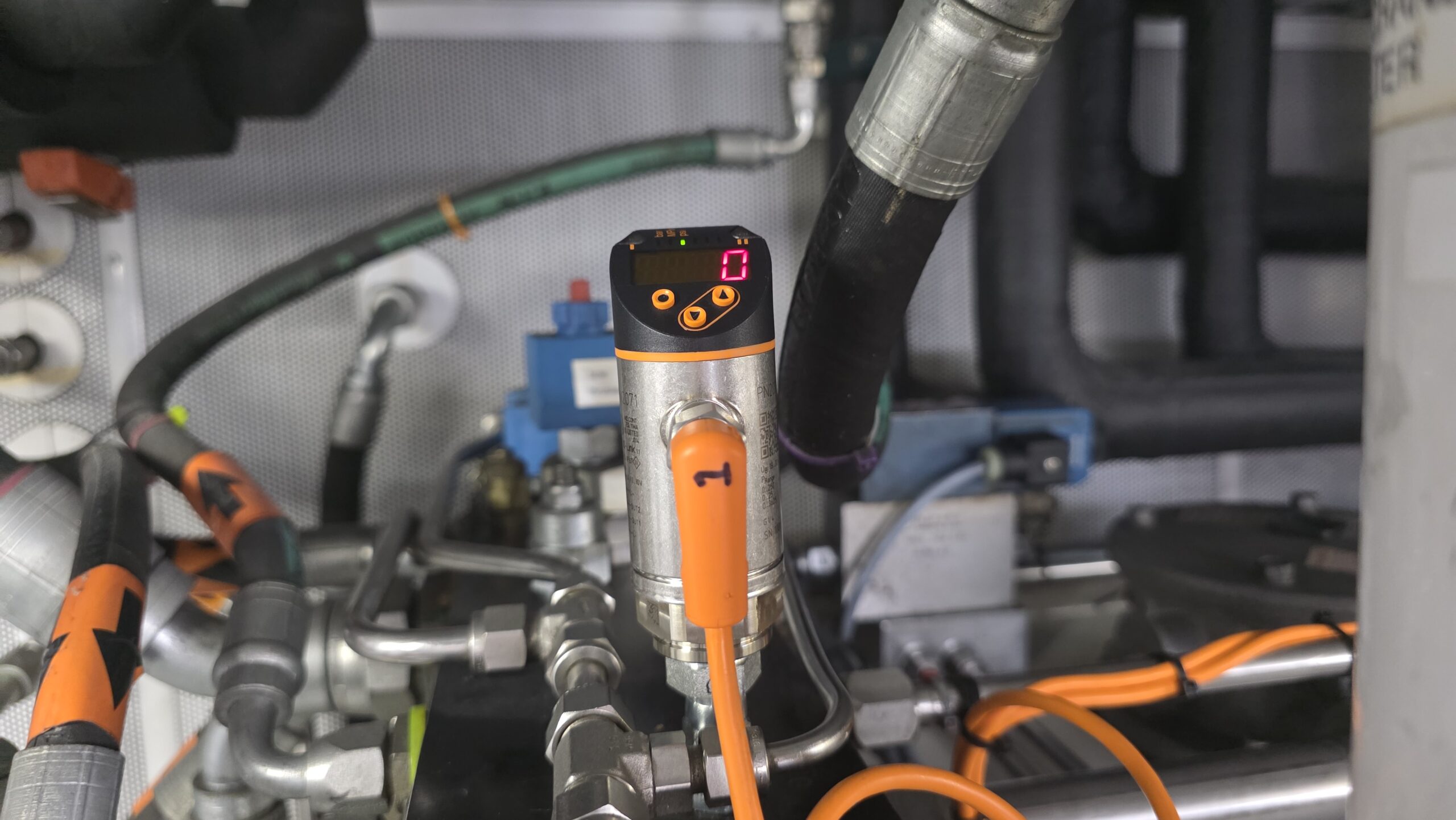
Logic moves into a supportable PLC. Display moves onto an HMI the crew can read without a vendor laptop. Local stations stay where people can see the door, the pocket, or the quay. Wheelhouse or ECR gets status, fault, and the right to stop, not a free hand to deploy while the bosun is still in the gap. WAGO PFC200 class controllers, Beijer HMI pages, and IFM sensors when the field needs a digital confirm are tools you can still buy, not a brand sermon. Spare parts in a locker beat a discontinued CPU.
Keep sound iron on a yacht PLC retrofit
Sound iron is what captains already trust on a good day. Cylinders that stroke. Pins that pin. Door leaves that still seal. Manifolds that still hold when power drops. If a surveyor can call that hardware honest, do not let a controller quote become a plant quote. Keep the iron. Change the brain.
Hydraulics make this blunt. Shared oil, sectional banks, a crane that steals flow mid-drop: the plant can still be fine while the sequence looks haunted. Soft. Then a bang. Then a bosun who will not stand on the platform. A yacht PLC retrofit that ignores the ring will paint green while the section starves. One that sees pressure, valve state, and confirms will wait, alarm, and stop.
One named example is enough. On a 46m Trinity Yachts (2002) hydraulic control refit, Koopnautic and Quantum aged out. Tanks, pumps, and valves stayed. The brain moved to a WAGO PFC200, a Beijer X2, and IFM where the field needed a digital eye. That is the pattern. Photograph what you have. Keep what still works.
A watertight door with honest locks does not need a new leaf because the mimic lied. A passerelle with true geometry does not need a new plank because the pendant died. A boarding bridge that still meets the quay does not need a new platform because the OEM CPU is a paperweight. Drive, confirm, and support the sequence that is already there.
Yacht PLC retrofit vs full plant replacement
Full plant replacement is tanks, pumps, valves, cylinders, and every line that feeds them. A yacht PLC retrofit is the controller layer: PLC, I/O, HMI, local stations, interlocks, and commissioning the watch can run after the yard leaves. Those are different invoices. Mixing them is how a control problem becomes a six-month rip-out nobody asked for.
Ask early. Why can you not drive the iron that is already there? Missing confirms, dead OEM logic, or a pendant with no spare: that is a retrofit. Scored cylinders, seized pins, or a door leaf that no longer seals: that is plant work, and the PLC conversation waits. Do not buy a new brain for a bent ram.
Scope creep loves the gray middle. A jumpered deadman does not mean the whole station must go. A fogged rotary does not mean the platform must go. Photograph the station. Photograph the switch. Replace the part that lied. Leave the part that still tells the truth. Write the yard list as control-only on day one, or it will not stay that way.
Plant replacement ends when oil is clean and strokes are smooth. A retrofit ends when pin out, pin in, door locked, stowed, deployed, traveling, and fault are states the watch believes. Timeouts that paint green are not confirms. If a motion is commanded and the confirm never comes, stop. Write that in English on the page.
Doors passerelles and boarding bridges on one PLC
Separate OEM brains for the door, the passerelle, and the boarding bridge are how the watch becomes the interlock. Mimic says door locked while the handle still turns. Mimic says passerelle stowed while the plank is still proud. Mimic says bridge home while the platform is still a lip at the threshold. Three lies compound. One supportable PLC that sees all three stops asking crew to be the safety system.
Interlocks run both ways. Door closed and locked before a platform or plank leaves the threshold. Platform or plank home and pinned before the door opens, unless you have a defined service mode with two people and a key, not a hidden engineer page. Hold-to-run on the local station. View of the pocket, the quay, and the door. Wheelhouse watches. Local moves.
Passerelle and boarding bridge are related iron and not the same sequence. Stern trunk, rotate, telescope, Med quay. Alongside wall, dock to side door, pin, last two hundred millimeters against a fender. Both belong on the same brain if they share the vessel and the risk. Both need pin confirms, home confirms, and a traveling state that is not painted as stowed. Ship-ring or dedicated pack, the sequence still needs those confirms. Pushbuttons without them are a relay panel with extra steps.
Yard window for a yacht PLC retrofit in Fort Lauderdale
Fort Lauderdale is where a lot of this lands, because that is where the boats already sit for other work. Newport the same, in season, with a shorter window. A yacht PLC retrofit fits those windows when the scope stays control-only and the iron is already sound. Kyle (Operations) keeps that window honest. Caleb (Head Systems Engineer) decides whether the sequence matches the iron. Adam (Electrical Engineer) decides whether the switches are even landed.
Day one needs boring specifics. Photos of the panel, local stations, door locks, pin, HMI, and any nameplates that still exist. A list of what the watch already does not trust. A clear line between keep-the-iron and replace-the-leaf. Without that, discovery fills the window, and a two-week controller job becomes a quote for steel you do not need.
Power loss and manual overrides belong on the commissioning list. The platform should not free-fall. The pin or manifold should still hold. Hand valves on the block should still turn. Ninety seconds of a real override beats a quay full of guests watching someone hunt for a lever. After the yard, the crew needs a name, not a generic inbox: who answers when a pin switch fails, where the spare coil lives, which page still runs if the glass cracks.
What to ask before a yacht PLC retrofit
Bring a short list. You do not need to become a PLC programmer. You do need answers a chief can live with after the yard leaves.
- Which iron stays, and who looked at doors, passerelles, boarding bridges, and hydraulics in person
- Which states are confirmed, and which are still a timeout painted green
- How door, passerelle, and boarding bridge interlock on one PLC, in both directions
- Local station versus wheelhouse: who can move it, and who can only see it
- Ship-ring or dedicated pack, and what else shares the oil during a drop
- What happens on power loss, and whether hand valves still turn on the manifold
- Spare pin switch, spare coil, spare HMI backup: in a locker, or a story
- Who the crew calls after Fort Lauderdale or Newport, by name
If a vendor cannot answer those without inventing hull numbers or promising a full plant swap, keep looking. A yacht PLC retrofit is definately the control job first: keep sound iron, replace the brain, land the sequences the watch already runs by feel, and leave them with a page that matches the dock.
Send photos of the panel, the door station, the pin, and the HMI to kyle@yachtautomations.com to start. Caleb will tell you whether the PLC can drive the sequence that is there. Adam will tell you whether the field devices are the job. Kyle will tell you whether the Fort Lauderdale window, or the shorter Newport one, can take a controller you can still buy. We would rather keep supportable doors, passerelles, and boarding bridges than sell you a plant you do not need.