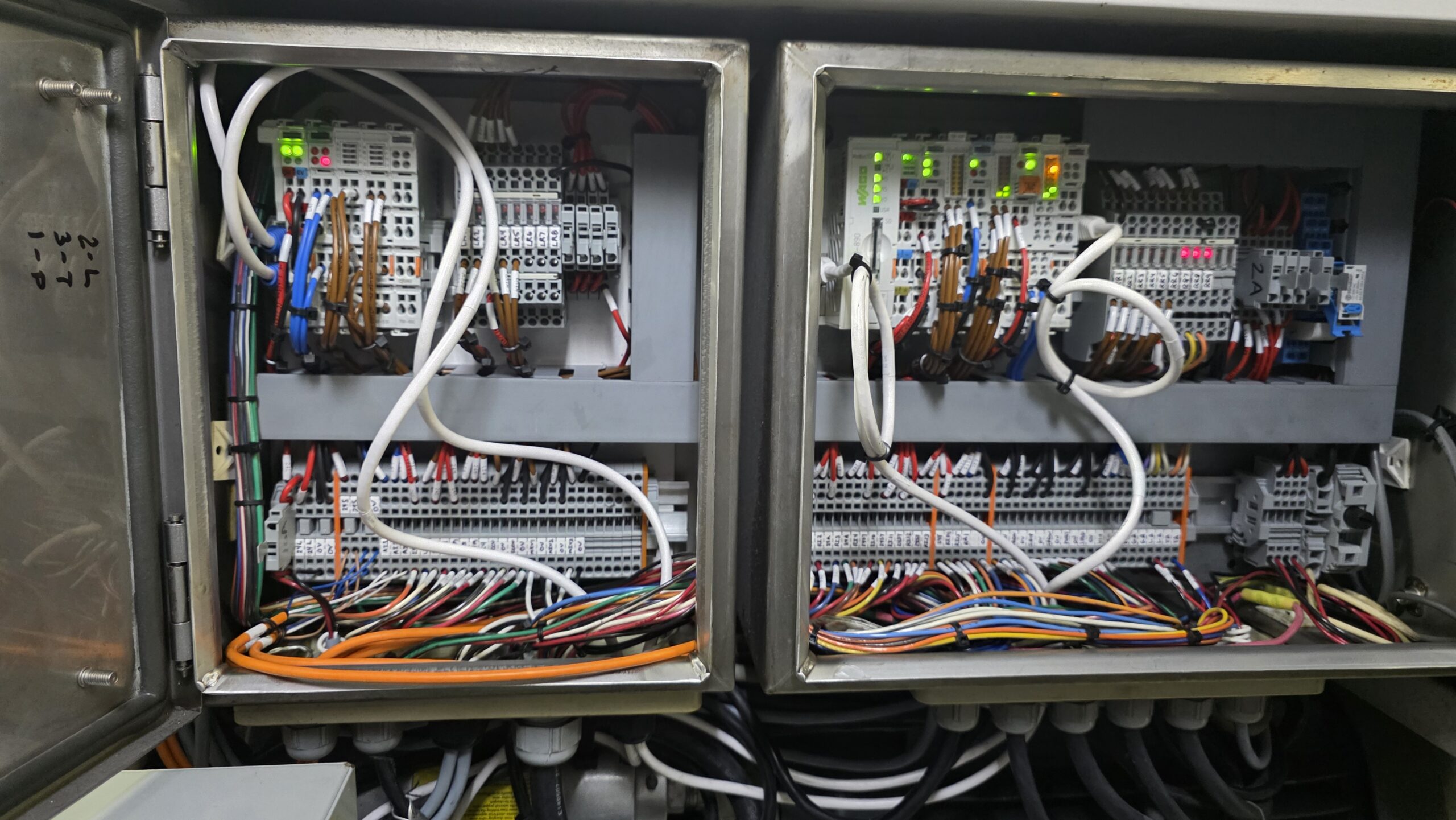
The spare is not coming. A captain calls because an obsolete yacht control system has a dead OEM board, the vendor stopped making it, and the boat is sitting. Pumps still make pressure. The door still seals. The passerelle still strokes. None of that helps if the card that used to run them is a part you cannot buy. This is a support problem. Keep the mechanicals when they are sound. Replace the brain.
Crew feel it before the management meeting does. A page that redraws slowly. A fault you clear twice a watch. A specialist in another time zone who might call back Thursday. Then the board dies for real, and you are not troubleshooting anymore. You are waiting on a part that is not in anyone's warehouse. Fort Lauderdale and Newport fill up with boats in that exact spot: good iron, dead electronics, a yard window that is already booked for something else.
What is an obsolete yacht control system in practice
Obsolete, here, is not a brochure word. It means the OEM controller, the operator panel, and the proprietary I/O are out of production and off the shelf. You can still find someone who remembers the platform. You cannot count on them being alongside the week you need them, and you cannot count on a substitute card arriving before the next movement. The yacht sits. Or you run a jumper that nobody wants to explain at handover.
That shape shows up on the systems we actually build around: PLC panels, yacht door systems, passerelles and boarding bridges. A hydraulic plant with tanks and valves that still work. A watertight leaf that still seals. A boarding bridge whose cylinders still stroke. The mechanical side can be fine for years after the electronics have aged out. Captains start carrying a mental list of which functions they trust. That is a bad way to run a boat.
The only named job we will put in writing is the 46m Trinity Yachts (2002) hydraulic control refit. Koopnautic / Quantum electronics aged out. Tanks, pumps, and valves stayed. That write-up is the hydraulic story. This one is the parts story that sits underneath it, and underneath a lot of boats that will never have a nameplate in a blog post. We are not going to invent a second yacht, a fake yard, or a made-up downtime number to make the point twice.
Unsupported yacht PLC hardware fails the same way whether it is running a door, a passerelle, or a hydraulic auxiliary. Intermittent first. Then a board you cannot buy. Then a sitting boat. If someone is selling you a full mechanical rip-out because the controller died, ask which pieces were condemned for wear and which were condemned because the vendor would rather sell a package.
Why a dead OEM board sits the boat
A worn pump is a known job. You can quote it. You can get a rebuild. A dead OEM board is a scavenger hunt. Proprietary CPU. A mimic with no spare glass. I/O that only talks to a laptop image from a company that got bought, then folded, then stopped returning mail. The boat is alongside. Charter week is on the calendar. The part is a rumor on a forum.
Crew already know the early signs. You power-cycle the panel more than you want to admit. A card runs hot. The HMI hangs on one page and comes back if you wait. Someone taped a note inside the door: do not kill power, it takes twenty minutes to come up. Then it does not come up. That is when the dead OEM board stops being a nuisance and starts being the reason you miss a movement.
The failure usually occured over a season, not in one blackout. A laggy page. A card you could not replace. A specialist who used to be able to clone the program from a surviving unit, until there was no surviving unit. Obsolete marine electronics do not announce themselves with a press release. They announce themselves when you try to order the spare.
Adam (Electrical Engineer) will tell you the ugly version. Field terminations that have been stabbed and restabbed for two decades. Labels that lie. A CPU you cannot identify without photographing the silkscreen and hoping a vendor still answers. Caleb (Head Systems Engineer) will tell you the software version: the logic lived on that dead board, there is no project file on the boat, and reverse-engineering a running plant from coils and hope is how a two-week window becomes the season. Kyle (Operations) will tell you the calendar version. Fort Lauderdale can absorb a control-only job inside a yard period you already have. It cannot absorb a parts hunt with no end date.
Can you keep the mechanicals on a yacht control retrofit
Yes. That is the point of a yacht control retrofit done honestly. If the tanks are clean, the pumps still make pressure, and the valves stroke, you do not need a new hydraulic room. If the door still seals and the track is true, you do not automatically need a new door. If the passerelle cylinders still pin, you do not need a new plank. You need electronics you can still buy.
A lot of quotes are structured the other way. Full plant replacement is easier to spec from a catalog. It is also a longer yard period, more class conversation than you may need, and a bigger hole in the operational calendar. Control-only is the reason this job fits next to paint, interior, or a survey window instead of becoming the window.
What usually comes out: the OEM controller, the tired operator panel, the field terminations that no longer match any drawing, sensors that report maybe. What should stay: the mechanical plant that was looked after. What should go in: a PLC still in production, modular I/O so the next function does not require a new CPU, an HMI the night watch can read, feedback that alarms in English instead of sitting on a gauge nobody glances at until the oil is already dark.
We use WAGO, Beijer, and IFM for that reason. Industrial hardware with a marine track record. Not a sealed yacht-only box whose last spare lives in a drawer two time zones away. Custom belongs in the logic and the pages, because this captain's Med moor and this door schedule are specific. Custom should not mean a unique controller you cannot replace. That is the line. Hold it in the spec, not as a favor after commissioning.
Old field cable is a judgment call. If the insulation is sound and the numbers still exist, land it on the new terminals and move on. If it has been patched for twenty years, budget the pull. A new brain on tired conductors is a pretty lie. Captains should ask which cables are being reused, and why, in writing, before the old enclosure comes off the bulkhead.
How do you replace an unsupported yacht PLC
You do not start with a screwdriver in a live engine room. You start with whatever still exists: schematics, an I/O list, photos of the panel with the cover off, the crew's list of which functions they no longer trust. Even a faded drawing beats a walkthrough guess. Then you spec a control-only scope. Which assemblies come out. Which mechanical items stay, and who inspected them. What the watch will see on the new screen. Where the spare CPU will sit after the yard leaves.
Logic in the PLC. Display on the HMI. If the Beijer goes dark, the plant should sit in a defined state, not a random one. Captains should ask that in the first meeting. Same question on a door package, a passerelle, or a hydraulic auxiliary. If the screen fails, what still runs, and what is locked out on purpose. An unsupported yacht PLC often hid that answer inside a sealed OEM board. The replacement should not.
Commissioning is function-based. Each output. Each interlock. Combinations the crew actually use, because a yacht is not a lab bench. A door from local and from remote. A passerelle through stow and deploy with the pin confirmed. A hydraulic function the watch actually calls at 0200. Other trades will still be in the space. Fine, if nobody is painting a limit switch, lifting a feedback pair, or "temporarily" jumpering a safety the night before sea trial. Newport in season has the same problem and less calendar. Plan as if the other trades do not read your emails.
Documentation is part of the spare. Schematics. Bill of materials with real supplier names. An I/O list with terminal numbers that match the wire labels. A short crew note, not a forty-page PDF. If the only person who can explain the system is the person who coded it, you do not have a delivered system. You have a dependency. The next technician through a crew change should open the door and work.
Doors hit this pattern as often as hydraulics. Indication that lies, a mimic with no spare lamps, a CPU nobody stocks. We wrote that as a door job separately; the parts problem is the same. See when a yacht door control system starts lying to you if the leaf is the subsystem holding you alongside. Passerelles rhyme with it: pin confirmation, local station, a board you cannot buy. Same rule. Keep the mechanicals. Replace the brain.
What obsolete marine electronics do to the next spare
Before the retrofit, the spares conversation is a prayer. After it, the conversation should be boring. WAGO hardware, a Beijer panel, IFM sensors, terminals you can order by part number. These are current-production industrial parts. They show up in marine work because they survive it, but they are not trapped inside a single yacht-vendor warehouse. That is the practical definition of supportable: you can still buy the next CPU or the next HMI without waiting on a company that stopped making the old one.
Put the spare on the boat, not in a warehouse two time zones away. CPU. A couple of I/O slices that match what is fitted. The HMI if it lives on that door. Write the part numbers on the drawing. Write where the box sits. A Fort Lauderdale shop is a fine backup. The boat is better for the thing that kills a Saturday. Newport the same, in season, with less room to wait on freight.
Class still cares, even when the job is "only" electronics. Lloyd's, DNV, Bureau Veritas each have their own flavor of what they want to see. None of them are impressed by an unsupported controller and a handwritten bypass list. A modern PLC with logged alarms, sensor feedback, and a documented I/O list is an easier survey conversation than a dead OEM board with a jumper that has been there for two seasons. We will not pretend a logo on a datasheet is your class certificate. Your job is a package that can answer what happens on power loss, what still indicates, and whether the log matches the plant.
Obsolete marine electronics also train bad habits. Crew stop using the screen and go back to the bypass. Then you have an expensive panel and the same operational risk you started with. The HMI has to tell the truth in English a bosun can act on. Travel timeout. Mismatch. Low pressure. A sequence that did not complete. If you need a speech to explain a page, the page is wrong. Twenty minutes of walkthrough, not a binder.
What to ask before you replace an obsolete yacht control system
Bring a short list to the meeting. You do not need to become a programmer. You do need answers a chief can live with after the yard leaves.
- Which mechanical items are staying, and who inspected them
- Exactly which electronic assemblies are coming out (controller, HMI, I/O, sensors)
- Whether the CPU and HMI are still in production, who sells them in the US, and where the spare sits (boat, Fort Lauderdale shop, vendor)
- What the crew will see on the HMI, including alarms in English
- If the HMI fails, what still runs, and what is locked out on purpose
- Which field cables are being reused, and why
- Who commissions onboard, and who the crew calls after the yard, by name
Notice what is missing. Guest graphics. Mood lighting. How close the door sticker is to the GA. Those can wait. They should not drive a parts problem that has the boat sitting. If a proposal leads with a render and buries the spare-parts list in an appendix, you are looking at the wrong job.
If you want that conversation, start with Yacht Automations out of Fort Lauderdale or Newport and send whatever still exists. A faded I/O list. A photo of the dead OEM board. The crew's fault log. We would rather tell you the mechanicals should stay than sell you a room full of new steel you do not need. An obsolete yacht control system is usually an electronics problem with a sitting boat attached. Treat it that way and the watch gets a plant they can run, a spare they can buy, and a yard window that does not become the season.