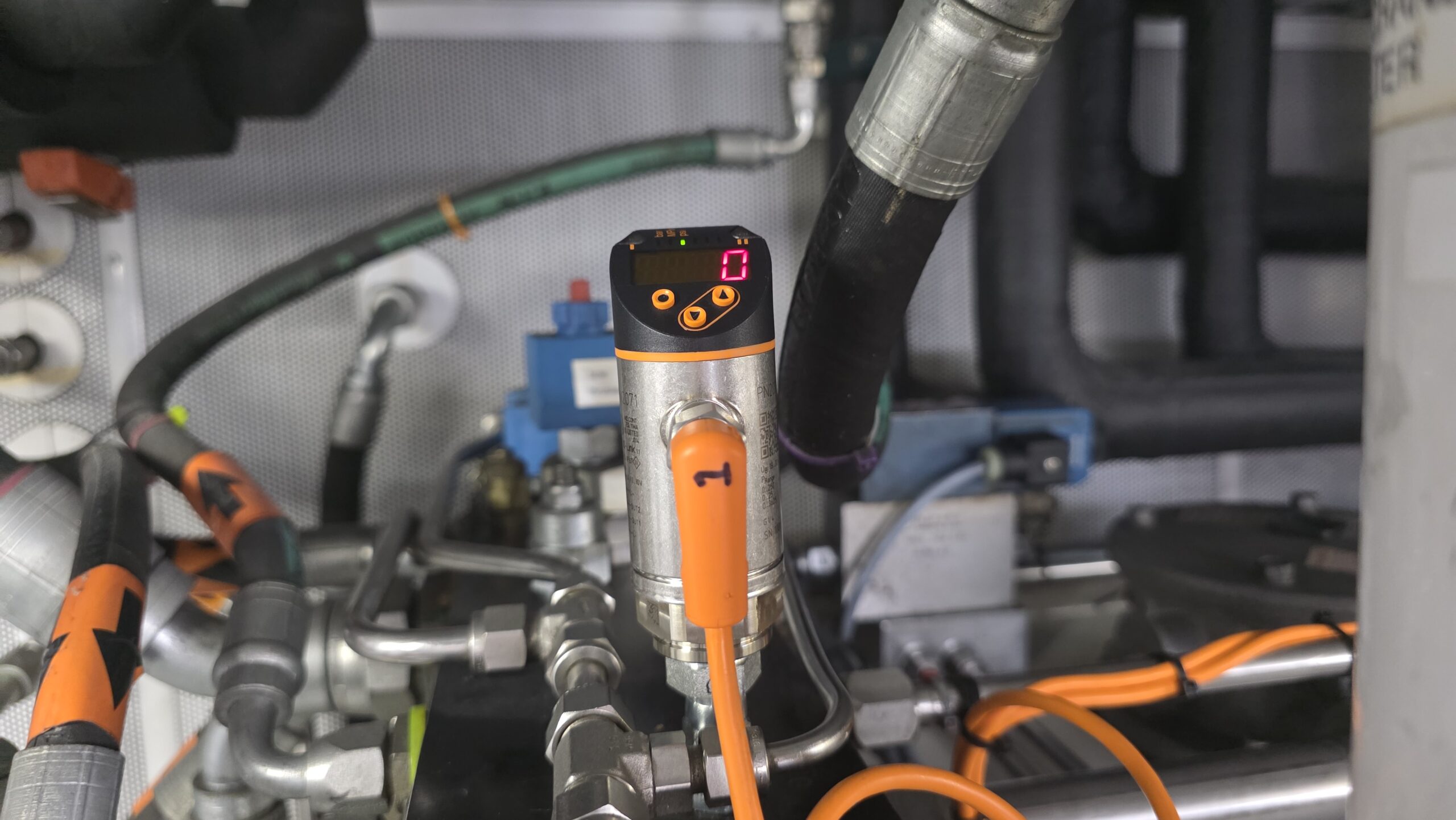
A yacht PLC control panel is the box you actually live with after the HMI demo is over. Captains and chiefs open that door at 0200 with a flashlight and a bad feeling. If the rail is a nest, the labels lie, and the spare slices were never fitted, you are looking at a delay with a hinged cover. We already covered how to evaluate the PLC and the HMI. This is the hardware: enclosure, DIN rail, terminations, I/O, and what you should see when the cover comes off.
Hydraulics, a stubborn auxiliary, the ugly subsystem holding you in the yard: all of them land in a panel. The crew does not care that it is programmable. They care that the next person through a crew change can open the door and work. Fort Lauderdale and Newport are where those conversations start for us, because that is where the boats are already open.
What a yacht PLC control panel looks like with the cover off
Start at the door. Gasket that still compresses. Hinges that do not sag. A lock you can open without a special key that lives in a drawer two time zones away. Inside, the layout should read the way a drawing reads. Power in. Isolation. 24 volt. PLC. I/O. Field terminals. Not a souvenir of whoever had the last weekend in the yard.
Adam (Electrical Engineer) will tell you this until it sticks. You should put a finger on a terminal and find that number on a sheet without calling the person who built it. If you cannot, the next tech will guess. Guessing in a live panel is how you take a plant down that did not need to come down.
What the watch should actually see:
- A DIN rail that is still a rail, not a pile of adapters and leftover junk
- CPU and I/O slices seated, keyed, and not hanging on a last remaining clip
- Field landings on cage clamp, labeled both ends, ferrules where they belong
- Spare I/O, spare terminals, spare rail real estate, not a promise to add it later
- A drawing pack that matches the wire numbers in front of you
Heat and clearance matter more than the sticker on the door. Stuff a marine PLC panel against a hot bulkhead with no air over the CPU and it will cook itself in a Fort Lauderdale summer even if it behaved on a bench. Leave space. Leave a path for a hand. Leave room to pull a slice without dismantling the neighbors.
Status LEDs should be visible with the door open and a flashlight, not buried behind a duct. Fuse holders should be labeled with the actual circuit, not F1 through F12 and a legend that fell out of the pocket. A chief who has to photograph every landing because nothing is printed is already behind. That photo session is the job the panel builder skipped.
Marine PLC panel enclosure, heat, and where it lives
The enclosure is the first decision that ages badly. Too small and you will never add a function without a second box. Too big and it becomes a junk drawer for whoever walks past with a spare relay. Size it for the job plus growth. Then put it somewhere a person can stand in front of it without lying on a tank top.
Location fights you on every yacht. Engine rooms cook. Lazarettes sweat. A dry workshop space is a gift and it is often already taken. Ask where condensate will go if the door is opened after a night at sea. Ask whether the glands point down. Ask who else will drill this box during the same yard period. Paint crews, interior, a plumber looking for a home for a transformer. Kyle (Operations) cares about that because a hole in the wrong face is a leak you find after the boat has left.
IP rating is a start, not a finish. Gasket, gland plate, drip loops, and whether the door still shuts after the last cable went in. A panel that only seals on the drawing is open to the space it lives in. Fort Lauderdale humidity will find that gap. Newport in a cold snap will find it as condensation on the rail. Neither looks like a PLC problem until the first slice goes intermittent. Then it is all you talk about for a week.
Mounting is part of the enclosure, not an afterthought. Unistrut that actually hits structure. Vibration isolation if you are on a bulkhead that rings. A door that can sit at 90 degrees without falling on a shoulder. Captains should stand in the space during the walkthrough and try the motion. If you have to hold the door with one hand and a meter with the other, the box is in the wrong place or the hinges are wrong.
Power feed belongs in the conversation before the enclosure is ordered. Dedicated run. Isolation you can lock out. 24 volt sized for the I/O plus the HMI plus a future slice. Sharing a convenience board with a coffee machine is a joke until it is not. Indication that dies when the main does is a second problem. Write both down before anyone cuts metal.
WAGO yacht panel: DIN rail, cage clamp, and labels
A WAGO yacht panel is industrial hardware that happens to survive boats. We use the PFC200 line. Modular I/O on a 35 millimeter rail. Cage clamp terminations. You can still buy the next slice. That is a captain argument the first time a conductor has to come off during a charter week, not a brand lecture.
Cage clamp holds in vibration. It lets go when you mean it to. Screw terminals loosen, then they take the neighbor with them when you lift a wire in a hurry. Ferrules on stranded conductors so the strands do not splay. Labels on the wire, on the terminal, and on the drawing, same number. If those three disagree, the panel is not finished. Do not accept a Sharpie on heat shrink as the documentation pack.
DIN rail layout is a habit. Keep mains and 24 volt on seperate sides of the rail so a dropped screwdriver does not become a week. Keep the PLC where you can see the status LEDs without standing on a hose. Group field terminals by system, not by the order the electrician happened to pull cable. A hydraulic landing next to an unmarked analog is how 0200 becomes a tracing job. Put duct on the verticals so the next person is not fighting a bird's nest to reach a clamp.
Beijer is the crew-facing glass, and it usually lives on a door or a remote station, not buried in the rail. IFM sensors land as honest I/O, not as gauges nobody glances at. None of that replaces a labeled rail. If the cover is off and you cannot tell a digital in from an analog in without a laptop, the physical job failed even if the pages look fine.
Wire numbers that match both ends of a run are the cheapest insurance in the room. Field cable into the gland, to the terminal, to the I/O, same ID. When a limit switch fails in a trunk, you want to lift one conductor. You do not want to ring out a bundle because the last yard used colors and hope. Colors fade. Numbers do not, if they were printed and they were kept.
I/O slices, spare capacity, and the map that has to match
I/O is where panels lie. A quote that lands every point with no spare is a quote that hopes you never add a hatch, a pump, or an alarm group. Fit spare digital in, spare digital out, spare analog. Leave empty rail. Buy the extra terminals now. The cost of a slice in the shop is nothing next to opening the boat in season because someone was proud of a tight layout.
The map has to match the wire. Terminal number, I/O address, field device, function in English. A memory dump or a spreadsheet that drifted after the last change order will not do. Caleb (Head Systems Engineer) owns the logic. He still needs Adam's landings to be true, or the nicest sequence in the world is talking to the wrong coil. Print it. Put it in the door pocket or in a pack the chief can find without a login.
Analog deserves its own look. Pressure, temperature, level. IFM into the PLC so low oil is an alarm, not a rumor. Shielded pairs landed correctly, not daisy-chained through a junction that someone will paint shut. 4-20 that is actually 4-20 on a meter, not close enough on the page. If a surveyor from Lloyd's, DNV, or Bureau Veritas is in the picture, this is also the evidence they will ask for. A labeled analog landing is easier to defend than a photo of a gauge.
Digital in should be dry contacts or sensors you can still buy. Digital out should be isolated from the coil they drive when the coil is nasty. Interposing relays earn their keep on hydraulics and on anything that will weld a transistor if you get cocky. Fuse per output where the failure mode is a dead plant. A single giant fuse that takes the whole rail with it is a panel that was built to a price, not to a watch.
Spares on the boat, not in a warehouse. CPU. A couple of I/O slices that match what is fitted. A handful of terminals. The HMI if it lives on this door. Write the part numbers on the drawing. Write where the box sits. Fort Lauderdale shop is fine as a backup. The boat is better for the thing that kills a Saturday.
Yacht control panel retrofit: shop-built vs onboard
A yacht control panel retrofit fails when someone starts with a screwdriver in a live engine room. The work that holds starts on a bench. Measure. Draw. Build the enclosure off the boat. Land the rail, the CPU, the I/O, the terminals. Test what you can with a simulator or a loom. Then take a finished panel to the vessel and land field cables once.
Fort Lauderdale is where a lot of that shop work happens for us, because that is where the boats already sit for other yard items. Newport the same, in season, with less calendar. Panels can be built off the boat. Field devices cannot be commissioned from a shop drawing. Plan the window as if the other trades will cut a feedback pair the night before sea trial. Sometimes they will.
The named example we will actually put in writing is the 46m Trinity Yachts (2002) hydraulic control refit. Koopnautic / Quantum electronics aged out. Tanks, pumps, and valves stayed. The enclosure was rewired onto WAGO cage clamp, PFC200 in, Beijer X2 as the face, IFM for level, pressure, and oil temperature. That job is a hydraulic story. It is also a panel story: the mechanicals were sound and the box was the liability. We are not going to invent a second nameplate to make the point twice.
Onboard install is landing, not redesign. Glands. Drip loops. Isolation. Each field cable to the terminal that the drawing named. Megger what should be meggered. Then function tests with the plant attached, because a yacht is not a bench. A thruster and a windlass at the same time. A sequence the crew actually uses. If the panel was built right, commissioning is proving the boat, not debugging the rail.
Build-outs during a yard period or an interior rebuild follow the same split. Shop for the box. Boat for the field. Electrical engineers on the vessel for the part that only exists once the cables are real. Do not let a schedule collapse those two into we will figure it out alongside. Alongside is how unlabeled wires get landed because the paint window moved.
Old field cable is a judgment call. If the insulation is sound and the numbers still exist, land it on the new terminals and move on. If it has been stabbed and restabbed for twenty years, budget the pull. A new rail on tired conductors is a pretty lie. Captains should ask which cables are being reused, and why, in writing, before the old enclosure comes off the bulkhead.
What captains should reject before a yacht PLC control panel ships
Bring a short list to the meeting. You do not need to become a panel builder. You do need answers a chief can live with after the yard leaves.
- Enclosure size, IP, gland plate, and whether a person can stand in front of the open door
- DIN rail layout: mains, 24 volt, PLC, I/O, field terminals, spare rail
- Cage clamp, ferrules, wire numbers that match the drawing on both ends
- I/O list with terminal numbers, spare slices fitted, spare CPU on the boat or in the shop
- Where it will be built (Fort Lauderdale or Newport shop versus onboard), and who lands the field
- Who the crew calls after the yard, by name, not a generic inbox
Notice what is missing. Guest graphics. How close the door sticker is to the GA. Those can wait. They should not drive the box. If a proposal leads with a render and buries the rail in an appendix, you are looking at the wrong job.
Custom still matters. A yacht is not a factory line. The hydraulics layout, the way this captain runs a Med moor, the ugly subsystem holding you in the yard, those are specific. Custom belongs in the logic and the landings. A unique enclosure you cannot get parts for is a trap. Caleb owns the sequence. Adam owns the panel. Kyle owns the window so this job does not become the reason you miss the season.
If you want that conversation, start with Yacht Automations out of Fort Lauderdale or Newport and send whatever drawings you have. Even a faded I/O list and a photo of the existing box with the cover off is data. We would rather keep a supportable OEM panel than ship a pretty enclosure the next tech cannot work on. The goal is a yacht PLC control panel the watch can open, the engineer can fault-find, and the next person through a crew change does not have to reverse-engineer from memory.