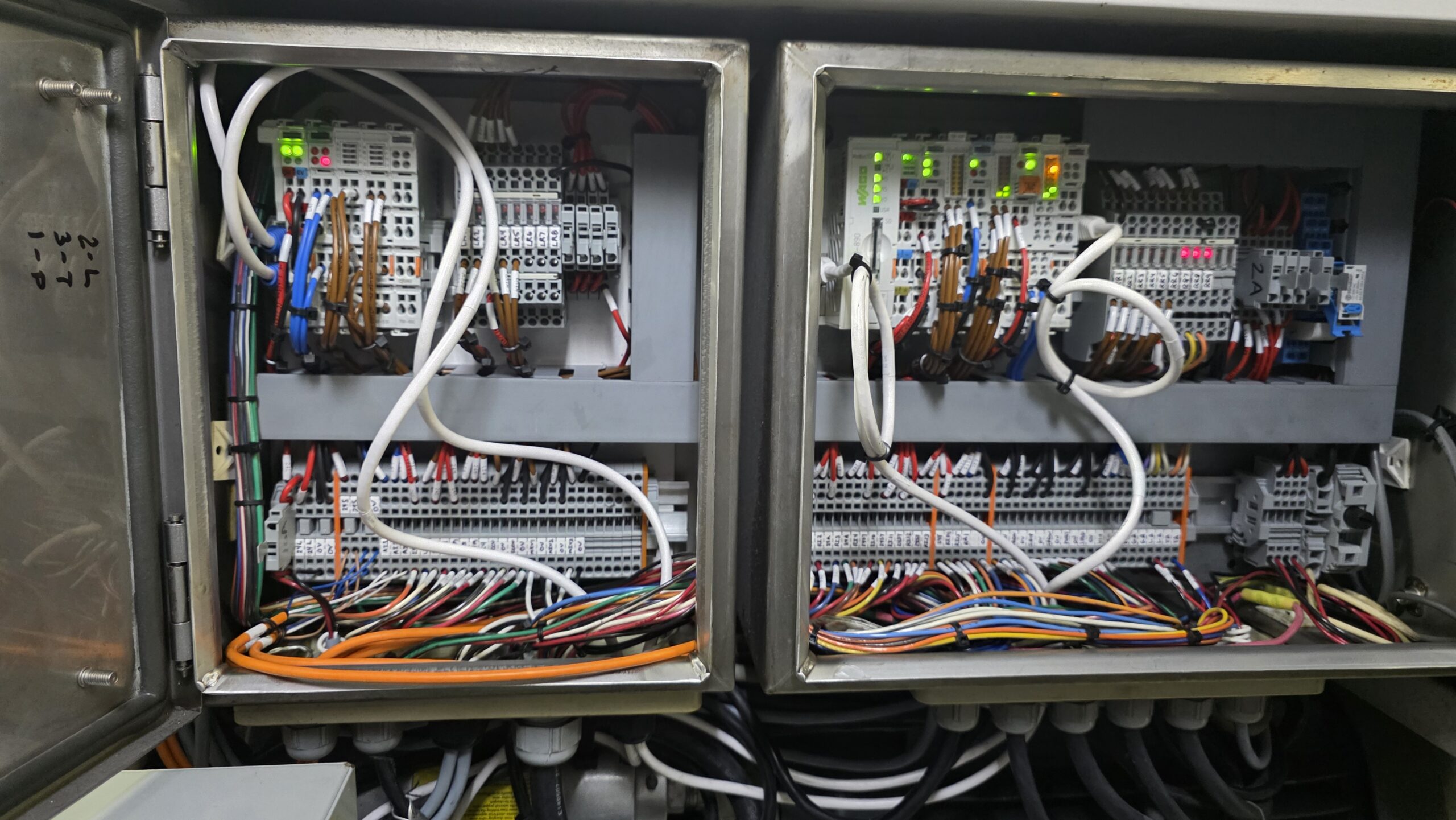
Captains search yacht passerelle retrofit when the stern plank still leaves the trunk, the cylinders still stroke, and the pin still seats, but the OEM pendant is a paperweight and nobody will sell a spare board. The teak is not the problem. The brain is. A yacht passerelle retrofit keeps the Med-mooring iron that is still honest and puts a supportable controller behind rotate, telescope, and pin confirmation, inside a Fort Lauderdale or Newport window the boat can actually take.
Yacht Automations does that work. Custom yacht controls for build-outs and retrofits. Our team of electrical engineers can get it done. Fort Lauderdale, FL and Newport, RI. PLC control panels, yacht door systems, passerelles and boarding bridges, and the automation around those. Guest lighting can wait. A passerelle that paints stowed while the bosun can still see plank in the air is a survey problem, and a person problem, not a brochure problem.
We already wrote how yacht passerelle control should run on a good night: stow, deploy, pin, local station the deck trusts. That page is the operations story. This page is the retrofit job when that OEM brain aged out. The wider keep-the-iron pattern across doors and bridges sits on our yacht PLC retrofit note. Here the geometry is stern-only: trunk, rotate, telescope, Med quay. Alongside walkways and side doors are a different sequence, even when a yard invoice still says gangway.
When obsolete passerelle control forces the call
Obsolete passerelle control fails in small ways first. A rotary limit box fogs and reports last Tuesday. A proximity sits a few millimeters off after someone painted the housing. A stow pin that never quite seats still trips a cheap contact because the contact was wired as pin-in-hole, not pin-home-and-confirmed. The page stays happy. The plank is not. Crew start walking the aft deck with a flashlight every time they call deploy. That habit works until the night it does not.
Then the electronics finish dying. Proprietary I/O. A pendant with no spare. A CPU a specialist in another country might still talk about if they are not already on a boat in Palma. The cylinders still stroke. The locks still pin. The walking surface is true. The quote that wants a new plank anyway is selling you steel you do not need. Keep the iron. Replace the controller with hardware you can still buy from a locker you can walk to.
Ship-ring hydraulics add their own flavor. A valve that shares a manifold with a crane. Pressure that dumps when someone else calls a function. A sequence that used to wait for pin confirmation and now times out and hopes. You get intermittent stow. Then you get a permanent stowed that is wrong. Then someone wedges the local lever because guests are already on the quay. A yacht passerelle retrofit that ignores shared oil will paint green while the section starves. One that sees pressure, valve state, and confirms will wait, alarm, and stop.
Electro-hydraulic packs fail cleaner and harder. Dedicated motor, small tank, dedicated valves, usually closer to the trunk. Easier to isolate. Easier to lose when the OEM sold pack and brain as one sealed story. Either way the control problem is the same. Unlock. Clear the trunk. Rotate or fold. Telescope. Lower to the quay, or into float if the boat lives with tide. Reverse it to stow. Confirm the pin. Then, and only then, tell the watch it is made.
Keep passerelle iron on a Med-mooring plank
Keep passerelle iron means what captains already trust on a good Med day. Plank true. Cylinders that stroke against a few degrees of list. Pins that pin. Manifold that still holds when power drops. If a surveyor can call that hardware honest, do not let a controller quote become a plank quote. Photograph the nameplate. Photograph the pin. Photograph the local station. Those three pictures beat a brochure every time.
Med-mooring geometry is the whole conversation. Stern trunk. Rotate out. Telescope. Meet a quay that may not be there in an hour. List and heel are not footnotes. A passerelle that deploys fine in a flat marina will fight a five-degree list on a windy Fort Lauderdale wall, and the same fight shows up against a Med quay with surge. Hydraulic pressure that was enough on the shop floor is not enough with the plank working uphill. Float mode, if you have it, is for tide against a fixed quay. It is not an excuse to skip pin confirmation. Self-centering and slew-lock still need the PLC to know they happened.
One named keep-mechanicals pattern is enough. On a 46m Trinity Yachts (2002) hydraulic control refit, Koopnautic and Quantum aged out. Tanks, pumps, and valves stayed. The brain moved to a WAGO PFC200, a Beijer X2, and IFM where the field needed a digital eye. That was not a passerelle job. It is the same honesty: keep sound mechanicals, change the controller. A yacht gangway retrofit that starts with new teak because the pendant died is the wrong invoice.
What leaves the boat is the OEM cover, the dead pendant, the I/O that only talks to that one board, and any field device that already lies. What stays is the plank, the cylinders, the pin hardware, and the manifold that still shifts when you feed it. Fogged rotaries and jumpered deadmen get replaced as part of the retrofit, not in week four as an afterthought. Write the yard list as control-only on day one, or it will not stay that way.
Passerelle PLC retrofit vs full yacht gangway retrofit
A passerelle PLC retrofit is the controller layer: PLC, I/O, HMI, local station, interlocks, and commissioning the watch can run after the yard leaves. A full yacht gangway retrofit is plank, cylinders, locks, walking surface, and every line that feeds them. Those are different invoices. Mixing them is how a dead pendant becomes a six-month rip-out nobody asked for.
Ask early. Why can you not drive the plank that is already there? Missing confirms, dead OEM logic, or a pendant with no spare: that is a PLC retrofit. Scored cylinders, seized pins, or a walking surface that is no longer true: that is plant work, and the controller conversation waits. Do not buy a new brain for a bent ram. Do not buy a new plank for a lying page.
Scope creep loves the gray middle. A jumpered deadman does not mean the whole station must go. A fogged rotary does not mean the plank must go. A photocell that nuisance-trips does not mean area sensing is optional forever. Aim it. Do not tape it. Photograph the station. Photograph the switch. Replace the part that lied. Leave the part that still tells the truth.
WAGO PFC200 class controllers, Beijer HMI pages, and IFM sensors when the field needs a digital confirm are tools you can still buy, not a brand sermon. Spare CPU, spare HMI, spare I/O slice on the boat beat a discontinued yacht-only board whose last spare lives in another country. Logic in the PLC. Display on the HMI. If the glass cracks, the passerelle should sit in a defined state, not a random one. Ask that in the first meeting.
Passerelle pin confirmation the watch needs
Passerelle pin confirmation is the gate everything else waits on. If the stow pin is in, nothing rotates. If the pin is commanded out and the switch never changes, you stop. You do not try it again into a bent ram. You do not call rotate or telescope on a green lamp that happens to be on. Write pin out and pin in as states the page believes, in English a bosun can act on at 0200.
Stow and deploy are not two buttons. They are a list of gates. Pin and lock first. Limit at the trunk. Full rotate made. Telescope in and out. Lower or float only after rotate and telescope tell the truth. Traveling is a third state. Stowed. Deployed. The ugly middle, where the plank is a crush and not yet a walkway. Two lamps cannot tell that story. Indication has to be independent of the command. A failed output should not paint a green stowed. Local lamps at the station, plus the bridge or ECR mimic.
People under the plank belong in the logic, not in a toolbox talk. Local deadman with a view of the trunk, the quay, and whoever is about to walk. Audible before motion. Photocells or area sensors if fitted, and if they nuisance-trip you fix the aiming. A wheelhouse deploy while a steward is still under the plank is how you get the remote taped over for the rest of the season. Then the finding has a name.
List is not optional on Med geometry. Occassionally a passerelle that was sweet in the shed will soft-start against heel and teach the crew to feather the lever by feel. That is the plant talking. The retrofit has to hear it: pressure or current that says the cylinder actually moved, timeouts that alarm instead of painting green, and a page that says traveling until the confirms arrive. Timeouts that paint done are not confirms. If a motion is commanded and the confirm never comes, stop.
Med passerelle controller replacement in Fort Lauderdale or Newport
Med passerelle controller replacement fits a yard window when the iron is already sound and the scope stays control-only. Fort Lauderdale is where a lot of this lands, because that is where the boats already sit for other work. Newport the same, in season, with a shorter calendar. Panels can be built off the boat. Field devices cannot be commissioned in a shop drawing. Kyle (Operations) keeps that window honest. Caleb (Head Systems Engineer) decides whether the sequence matches the stern geometry. Adam (Electrical Engineer) decides whether the switches are even landed.
Day one needs boring specifics. Photos of the trunk, the pin, the local station, the HMI, the valve labels, and any nameplates that still exist. A short list of what the watch already does not trust: which motion softens when another takes oil, which confirm paints early, which interlock got jumpered for a yard week and never came back. Without that, discovery fills the window, and a two-week controller job becomes a quote for teak you do not need.
Commissioning is function-based. Unlock. Rotate. Telescope. Lower. Float if you have it. Stow. Pin. Each local. Each remote. Combinations you actually use, because a yacht is not a lab bench. Deploy from the local with a pad in the path, in the yard, and see whether the obstruction behavior is real. Indication versus a person standing at the trunk calling states on the radio. Power loss and manual overrides belong on that list. The plank should not free-fall. The pin or manifold should still hold. Hand valves on the block should still turn. Ninety seconds of a real override beats a quay full of guests watching someone hunt for a lever.
After the yard, the crew needs a name, not a generic inbox: who answers when a pin switch fails, where the spare coil lives, which page still runs if the glass cracks. Spare parts in a locker you can walk to. Drawings and an I/O list with terminal numbers that match the wire labels. Twenty minutes of walkthrough on pages that tell the truth, not a binder nobody opens underway.
What to ask before a yacht passerelle retrofit
Bring a short list to the meeting. You do not need to become a PLC programmer. You do need answers a chief can live with after Fort Lauderdale or Newport leaves the boat.
- Is the stern plank, cylinders, and pin hardware sound, and did anyone photograph the Med geometry
- Pin out, pin in, rotate ends, telescope ends, traveling: which are confirmed, and which are still a timeout
- Ship-ring or dedicated pack, and what else shares the oil during rotate or lower
- Local station versus wheelhouse: who can move it, and who can only see it
- What happens on power loss, HMI failure, and a missing limit, including whether indication survives
- Spare pin switch, spare coil, spare HMI: in a locker, or a story
- Who the crew calls after the yard, by name
If a vendor cannot answer those without inventing hull numbers or promising a full plank swap, keep looking. A yacht passerelle retrofit is the control job first: keep sound stern iron, replace the OEM brain, land rotate-telescope-pin the watch already runs by feel, and leave them with a page that matches the quay.
Send photos of the trunk, the pin, the local station, and the OEM cover to kyle@yachtautomations.com to start. Caleb will tell you whether the PLC can drive the Med sequence that is there. Adam will tell you whether the field devices are the job. Kyle will tell you whether the Fort Lauderdale window, or the shorter Newport one, can take a controller you can still buy. We would rather keep a supportable passerelle than sell you a plank you do not need.