Captains do not call asking what a DIN rail is. They call because the last yacht-only controller has no spare, and someone in the yard is quoting another sealed box that looks marine and will age the same way. A WAGO yacht PLC control panel is the other option: industrial PFC200, cage clamp, modular I/O still in production. Hardware a chief can order by part number. Hardware a Fort Lauderdale or Newport shop can actually land.
We already wrote the broader yacht PLC control panel story: enclosure, rail layout, what a chief should reject before the box ships. Read that if you are arguing how the inside should look. This post is the brand on that rail. Why industrial WAGO instead of a yacht-OEM brick that only one vendor will still talk about.
The loads we put on that hardware are the ones we actually build around. Door systems. Passerelles and boarding bridges. Hydraulic auxiliaries when the mechanicals are still sound. Custom yacht controls for build-outs and retrofits. Our team of electrical engineers can get it done. Guest lighting can wait its turn.
Why specify a WAGO yacht PLC control panel over a sealed OEM
A sealed yacht-only OEM box can run clean the week it is commissioned. Then the vendor stops making the card. Proprietary CPU. I/O that only talks to a laptop image from a company that got bought. A spare board that lives on a forum. We have already written the parts-hunt version of that story. The short version here: do not buy the same trap twice.
Industrial WAGO is catalog hardware. The PFC200 line is still made. The I/O slices are still made. The cage clamp terminals are a commodity more than one US distributor will sell you, not a silkscreen only a specialist in another country will admit to. That is the captain argument the first time a door will not close in season and you need a digital input module by Friday.
Custom still belongs in the job. This door schedule. This passerelle pin logic. This hydraulic sequence the watch actually uses. Caleb (Head Systems Engineer) writes that. Hold the CPU to a family you can still buy. Put that in the spec. If a proposal leads with a marine-looking enclosure and will not name the CPU family, you are looking at another sealed story with a nicer door sticker.
Adam (Electrical Engineer) will put it blunter. He can pull a WAGO slice, land a spare, and send you a number that still exists in a catalog. He cannot do that with a board that has no second source and a program that lived only on the dead card. A vibrating engine-room bulkhead does not care that the old box said yacht on the nameplate. Fort Lauderdale humidity does not care either.
What a WAGO marine PLC still lets you buy next season
Supportable means you can still buy the next piece. CPU. Digital in. Digital out. Analog. The power supply that feeds the rail. End stops, jumpers, the cage clamp blocks the field lands on. Write those numbers on the drawing. Write which locker on the boat holds the spare bag.
A WAGO marine PLC shows up in marine work because it survives vibration and distributors still stock it. Yards like to see industrial approvals on a datasheet. We will not pretend a logo is your class ticket. Lloyd's, DNV, and Bureau Veritas each ask in their own voice. What they are not impressed by is an unsupported controller and a handwritten bypass list. Current production is what you can actually put on a purchase order after the yard has left.
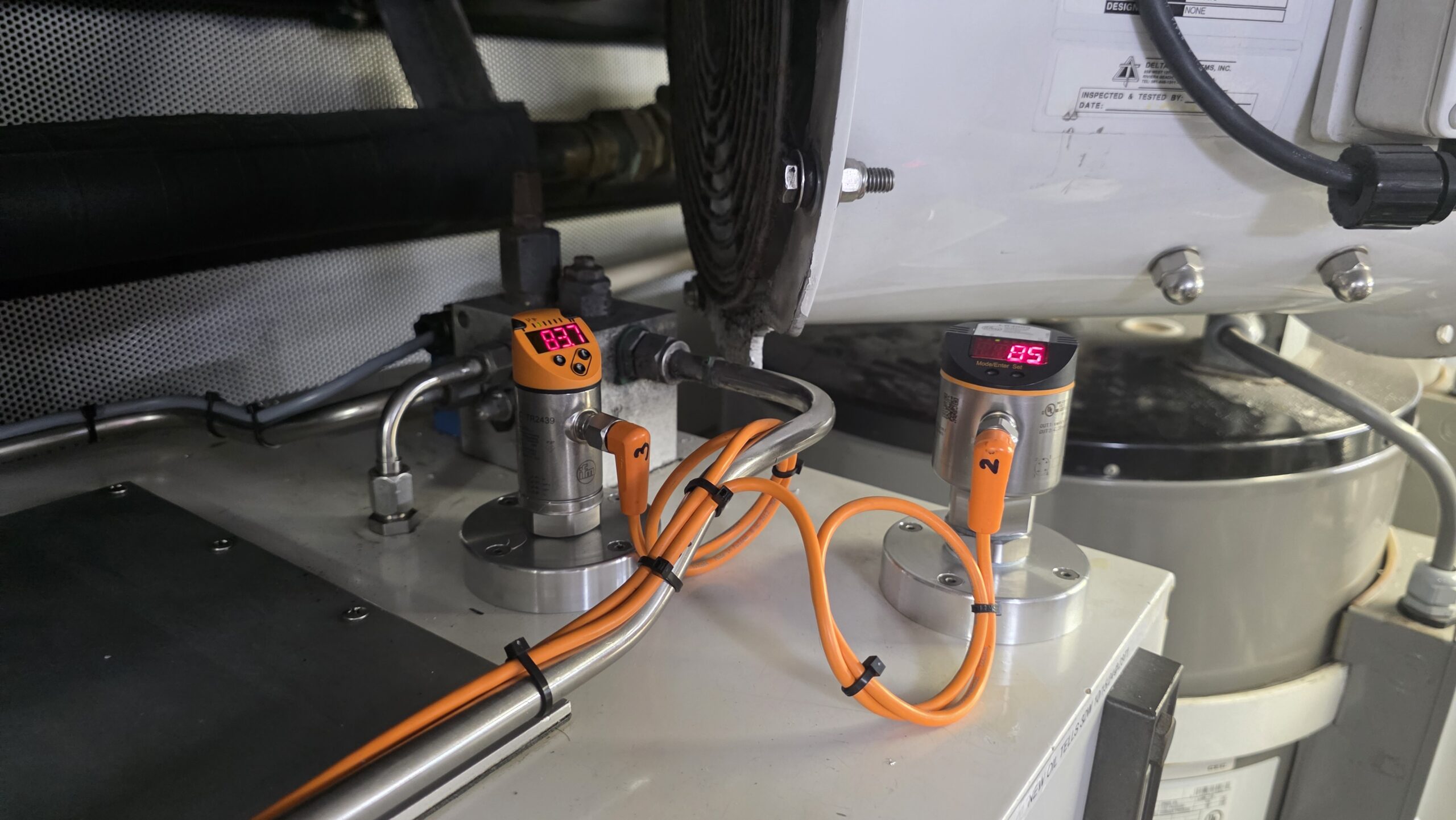
Beijer is the glass the watch presses. IFM is the sensor that tells the PLC the truth instead of sitting on a gauge nobody glances at until the oil is already dark. Those two sit around the WAGO rail on the jobs we will put in writing. Same reason: you can still order them. Put a spare HMI on the boat if the screen lives on this door. Put a spare IFM in the same box as the spare I/O slice. The Fort Lauderdale shop is a useful backup. The boat is the right place for the part that kills a Saturday.
Kyle (Operations) cares about lead time because the yard window does not care about a distributor backorder. Newport in season has less calendar. A twelve-week yacht-only CPU special already missed the window. A PFC200 you can overnight changes the conversation. Ask who sells it in the US, in writing, before anyone cuts a DIN rail.
Cage clamp on a marine WAGO control panel in the engine room
Engine rooms vibrate. Bulkheads ring when a genset is online. Screw terminals back off a quarter-turn at a time, then they take the neighboring landing with them when someone lifts a wire in a hurry. Cage clamp is the termination we rewire onto because it holds in that world and it opens when you mean it to. Operating tool in, conductor out, neighbor still tight. That is the whole pitch, and it is the thing a chief notices the first week a limit switch has to come off during charter.
Ferrules on stranded conductors so the strands do not splay in the clamp. Labels on the wire, on the terminal, and on the drawing, same number. If those three disagree, the marine WAGO control panel is not finished. A Sharpie on heat shrink is not a documentation pack. You should be able to put a finger on a landing and find that number on a sheet without calling the person who built it. Guessing in a live panel is how you take a door plant down that did not need to come down.
A vibrating ER is also why the PFC200 belongs where you can see the status LEDs with a flashlight, not buried behind a duct. You want to know the CPU is alive before you start tracing a passerelle that will not pin. Heat is real against a tank top in a Fort Lauderdale summer. Leave air over the rail. That is not an enclosure lecture. It is how industrial hardware still dies if you cook it.
When a conductor does need to come off, cage clamp comes off as one landing. Screw terminals that have been over-torqued for a decade often twist the bar. They turn a five-minute swap into an afternoon with the plant locked out. Captains feel that as a missed movement. Crew feel it as the call that pulls the engineer out of a tank.
WAGO I/O yacht slices when the next door or passerelle shows up
Modular I/O is why the next function does not need a new CPU. A watertight leaf added in the next yard period. A passerelle pin confirmation that was never landed. Another analog for pack pressure. Digital in, digital out, analog, a relay slice that isolates a coil that will weld a transistor if you get cocky. Fit spare now. Leave empty rail. A slice bought in the shop costs almost nothing next to a season opening because the layout was proud of how tight it looked.
The rail has to accomodate a spare digital slice and a handful of terminals without restacking the CPU. That sentence is the growth plan. A sealed OEM box is full the day it ships. A WAGO I/O yacht layout sized for the job plus a door, plus a boarding-bridge interlock, plus one ugly auxiliary you have not named yet, is a layout that survives the next request without a second brain.
Count the points before you believe a quote that says the rail is done. A sliding WT door is not two wires. Open, closed, traveling, local both sides, photocell or edge, audible, pack pressure if it is hydraulic. A passerelle is pin in, pin out, stow, deploy, rotate or fold limits, and usually a confirmation that the cylinder actually moved. That is a few slices. It is not a new PFC200. Group those landings by system so the next person is not ringing out a bundle because doors and hydraulics share a mystery row.
Caleb still needs Adam's landings to be true, or the nicest sequence in the world is talking to the wrong coil. Terminal number, I/O address, field device, function in English. Print it. Put it in the door pocket. The next technician through a crew change should clip on a slice without reverse-engineering from memory. Fuse per output where the failure mode is a dead plant. A single giant fuse that takes the whole rail with it was built to a price.
WAGO PFC yacht CPU: spare on the boat, not a rumor
The PFC200 is the CPU we actually put in. Modular I/O on the same rail. A project file a second technician can open, not a sealed laptop image from a vendor who has since been bought. If the Beijer goes dark, the plant should sit in a defined state, not a random one. Ask that in the first meeting. Logic in the PLC. Display on the HMI. A cracked glass during a Med season should be a courier problem.
The named example we will put in writing is the 46m Trinity Yachts (2002) hydraulic control refit. Koopnautic / Quantum electronics aged out. Tanks, pumps, and valves stayed. WAGO PFC200 in the panel, Beijer X2 as the face, IFM for level, pressure, and oil temperature, cage clamp on the landings. That job is a hydraulic story. It is also the WAGO-in-the-panel example: industrial CPU, still buyable, running plant that was already sound. We are not going to invent a second nameplate to make the point twice.
A WAGO PFC yacht spare belongs on the boat. CPU. A couple of I/O slices that match what is fitted. Write the part numbers on the drawing. Write which locker. A Fort Lauderdale shelf is a backup, not the plan for a Saturday in a seaway. Newport the same. If the only spare lives at a vendor two time zones away, you have a brochure.
Build the rail off the boat when you can. Then land field cables once. Commission the functions the watch actually uses: a door from local and from remote, a passerelle through pin confirmation, a hydraulic auxiliary the night engineer actually calls. Other trades will still be in the space. Plan as if they will lift a limit the night before sea trial. Sometimes they will. Newport in season has less room to absorb that.
WAGO yacht automation from an industrial PLC yacht panel shop
Supportability is a shop that stocks the family and a phone number that answers. Yacht Automations builds these panels in Fort Lauderdale, and in Newport when that is the season the boat actually gives you. WAGO yacht automation, for us, means the subsystems we lead with: doors, passerelles, the hydraulic auxiliary holding you alongside. An industrial PLC yacht panel is the box that runs them on parts you can still order after the yard leaves.
Who you call after the window matters. Send the existing box photo, cover off, and whatever I/O list still exists. A photo of the silkscreen on the dead CPU is useful. A note to kyle@yachtautomations.com is enough to start. Caleb will tell you whether the sequence belongs on a PFC200 you can still buy. Adam will tell you whether the landings are even a WAGO job. Kyle will tell you whether the Fort Lauderdale window, or the shorter Newport one, can take it.
Bring a short list to the meeting. You do not need to become a programmer. You do need answers a chief can live with after the yard leaves.
- CPU family still in production, who sells it in the US, and where the spare sits (boat, Fort Lauderdale shop, vendor)
- Modular I/O with spare slices fitted, and rail left for the next door or passerelle function
- Cage clamp landings, wire numbers that match the drawing on both ends
- What still runs if the HMI dies, and what is locked out on purpose
- Who lands the field in Fort Lauderdale or Newport, by name
We would rather keep a supportable OEM panel than ship a pretty enclosure the next tech cannot work on. If the sealed box still has a spare and a file, say so. If it does not, specify WAGO on purpose. The watch gets a panel they can open, a CPU they can buy, and a shop that already lives where the boats sit.