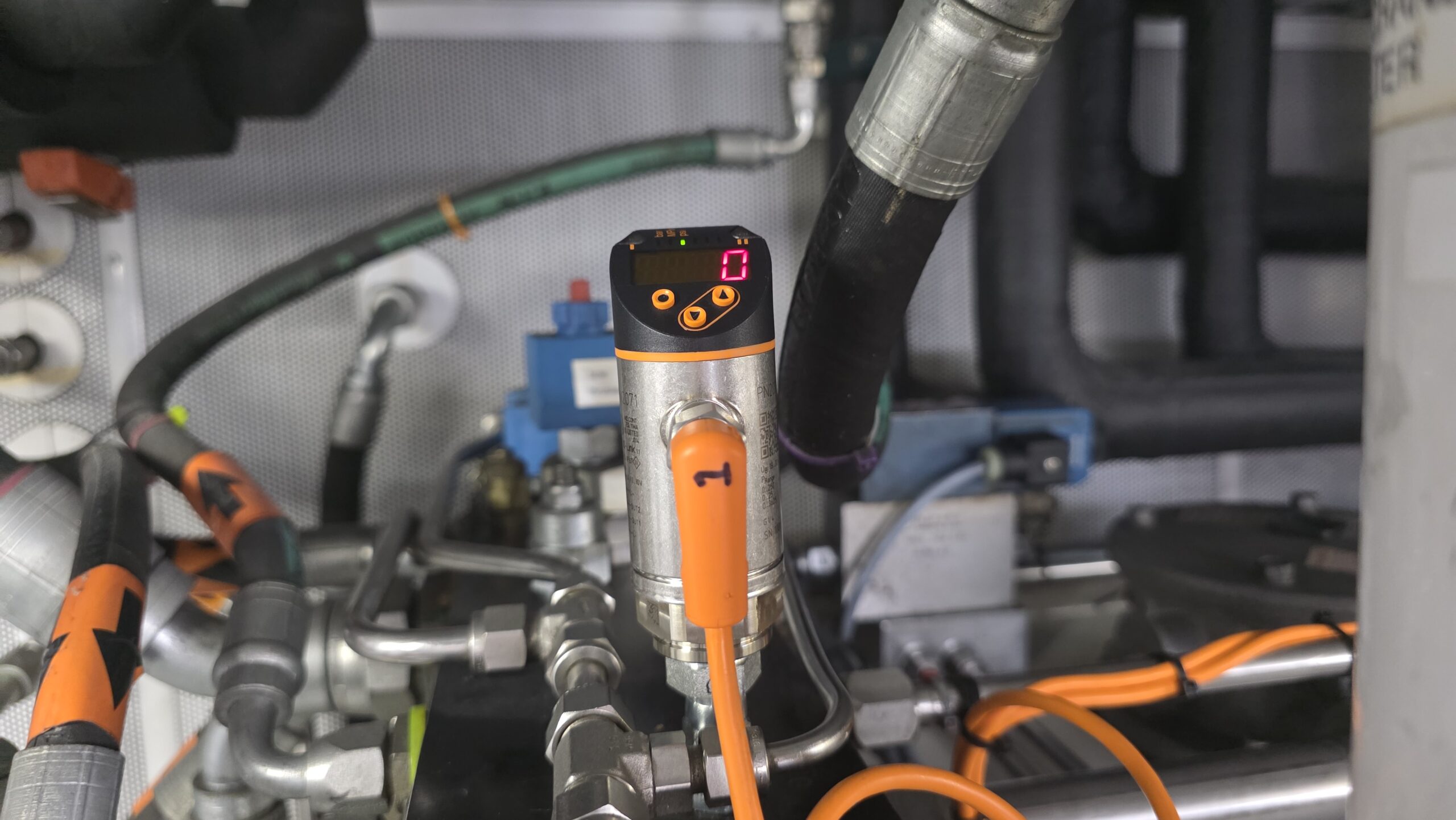
Captains do not call asking for a prettier gauge. They call because the night engineer walked past the same trunk for a week, the oil was already dark, and the pack still looked fine on a page that only knew the pump had been called. IFM yacht sensors are the field devices that stop that lie. Analog into the PLC. Level, pressure, oil temperature as numbers the logic can trip on. A confirm the watch can trust.
We spec them, land them, and alarm them in English. Fort Lauderdale and Newport, because that is where the boats already sit for other yard work. Custom yacht controls for build-outs and retrofits. Our team of electrical engineers can get it done. Guest lighting can wait. The watch needs a sensor that tells the truth about the plant they actually run: doors, passerelles, hydraulic auxiliaries.
What IFM yacht sensors have to confirm for the watch
Commanded versus confirmed is a glass problem and a field problem. The screen is where the watch sees both columns. We already wrote that as a Beijer HMI yacht job. This is the other half. The confirm has to be a real sensor sitting on the plant. If the only thing the PLC knows is that it energized an output, the watch is flying on hope. A dead 4-20 that still paints a healthy bar is how people get hurt.
A door limit is a useful example, then we are done with doors. Open, closed, traveling. One cheap closed contact cannot prove the leaf. A passerelle pin is the same shape: pin out commanded, pin out confirmed, then rotate. Those are digital confirms. Hydraulics need analog as well. Pump called still has to show pressure arrived. A tank still has to show up as a number, not a sight glass someone last wiped in port. Write the confirm into the spec as a device.
Timeouts belong with that device. If the confirm never comes, the logic stops and the alarm says so in English: low pack pressure, level under the line you agreed with the chief, oil temperature that climbed while the pack was loaded. A bosun should read the banner, go to the plant, and do something. Caleb (Head Systems Engineer) will care whether those confirms are actually in the sequence. Indication has to be independent of the command. If a vendor quotes a hydraulic auxiliary with no analog on the pack, ask what the PLC is supposed to believe after the output fires.
IFM marine sensors the watch can still buy next season
IFM marine sensors show up in this work because they survive the space and you can still order the next one. Salt air. Engine-room vibration. Heat against a tank top in a Fort Lauderdale summer. Catalog hardware matters the first Saturday a 4-20 goes open in a seaway and you need a replacement with the same range, not a redesign.
Yards like to see marine approvals on a datasheet. DNV and Bureau Veritas logos exist on a lot of industrial field devices. We will not pretend a logo is your class ticket. What they are not impressed by is a dead proprietary sender and a handwritten note on the tank that says "looks ok." Current production is what you can put on a purchase order after the yard has left.
Adam (Electrical Engineer) will put it blunter. He can land a shielded pair, scale a 4-20, and send you a part number that still exists. He cannot do that with a yacht-only sender that only talks to a board you cannot buy. Match the range to the plant. A 0-400 bar cell on a 200 bar pack wastes resolution. A sender that maxes out under working pressure is a different kind of lie. Write the range, the process connection, and the electrical type on the drawing. Digital confirms still count: proximity, pressure switches, limits you can aim after paint. Strain relief and a gland that still points down matter when the sensor is the only thing that knows the tank is empty.
Yacht hydraulic sensors for level, pressure, and oil
The named plant we will put in writing is the 46m Trinity Yachts (2002) hydraulic control refit. Koopnautic / Quantum aged out. Tanks and valves stayed. IFM went on for level, pressure, and oil temperature so those three values lived in the PLC instead of on gauges. That job is a hydraulic story. This post is the field devices: why those three sensors were the confirm, and why a captain should ask for the same honesty on the next pack. We are not going to invent a second nameplate.
Three values because a hydraulic auxiliary fails in those three ways more often than a pretty mimic can catch. Empty tank. No pressure when the pump is called. Oil that cooked while nobody was in the trunk. Yacht hydraulic sensors that only cover one of those leave two holes. A pressure cell with no level will let you run the pack dry. A level sender with no temperature will let you polish a bearing. Fit the set the plant actually needs, then alarm them as a set.
The mechanicals can be sound and the electronics can still be mute. Keep the tanks, the pumps, the valves if they still stroke. Replace the senders that drifted into the maybe-that's-right category. Analog the PLC sees continuously. Low oil and high temp as a crew problem on the HMI, not a seized pump three hours later. Kyle (Operations) will tell you whether that sensor swap fits the Fort Lauderdale window you already have, or the shorter Newport one you cannot slide. Field devices cannot be commissioned from a shop drawing. Ask which senders are coming off, which IFM units are going on, and what engineering units the watch will see. Bar or PSI. Degrees the engineer already thinks in. Percent of tank, not a raw count. If the proposal cannot name those three, the confirm is still a gauge.
Yacht pressure sensor PLC analog that alarms in English
A yacht pressure sensor PLC landing is a 4-20 into an analog in, scaled to the pack, alarmed at the values the chief will live with. Pump called, pressure arrived. That is the confirm. If the output is on and the analog is still sitting at tank head, the sequence stops. The banner says low pack pressure, in English, with the pack name a bosun can walk to.
The existance of a live 4-20 on that analog in is the difference between a green coil and a plant that actually made pressure. Commission it with a meter. Four milliamps at the bottom of the range. Twenty at the top. If you are at 3.5 or 21, you have a loop fault, not a process value. Sensor fail versus low pressure. Rank them with the chief before anyone picks a trip point. A pack that will not make pressure should not keep a windlass or a passerelle cylinder hunting.
Shielded pair. Drain landed at one end. Process connection that still seals after the last painter. Isolation so a dead sender does not take the analog slice with it. If the only pressure the watch has is a glycerin gauge behind a door they do not open underway, you have a museum piece. Setpoints belong in the logic, not on a sticker that will get painted over. Low inhibit so you do not call a function that cannot finish. High that means a relief is lifting or a sender is lying. The night engineer should see the live bar, the trip, and whether the mismatch is still active.
IFM level sensor yacht tanks the night engineer can see
An IFM level sensor yacht installation is the tank talking to the PLC, continuously. Sight glasses fog. Dipsticks lie after a list. A float that stuck in 2019 is still stuck. Continuous analog is how low oil becomes a banner while you can still add fluid, not a dry suction at 0200. Put the sender where the tank actually empties, not where it was easy to hot-tap in the last yard period. A high mount that never sees the last third of the volume is a decorative 4-20.
Alarms in English again. Low level. Low-low if the pack should inhibit. A mismatch if the pump is called and level is falling faster than the function can explain. The watch does not need a tank farm graphic. They need a number, a trip, and a name that matches the tank in the space. If two packs share a tank, say so on the page and on the drawing. If they do not, do not let a vendor combine them because the I/O list was short.
Hydraulic tanks are the lead because that is the plant we will name. The same honesty applies anywhere a level is the confirm: a reservoir on a door pack, a header that feeds a boarding-bridge cylinder. Ask where the low alarm is, who hears it, and whether the function inhibits. Then generate the low in the yard, on purpose. Adam will care that the analog is actually 4-20 on a meter at the slice. Caleb will care that low-low is in the sequence for every function that drinks from that tank.
Marine oil temperature sensor before the oil goes dark
A marine oil temperature sensor earns its keep on the pack that is working hard, not on the tank someone checks during a Friday round. Dark oil is already a story. High temperature is the chapter you can still act on. Analog into the PLC. High alarm in English. Inhibit if the chief wants a pack to sit rather than polish itself. The watch should see the live degrees next to the pressure, not a separate gauge two decks away.
Placement matters more than the brand stamp. In the flow, or in a well that actually sees the oil the pump is using. A sender on a dead leg will sit pretty while the case drains heat into the space. Fort Lauderdale alongside in August will make that lie worse. Newport in a cold snap will make a low-temp story you should also have a line for, even if high is the one that kills bearings. Write both if the plant can get there. Do not copy a trip point from a different pack because it looked neat in a spreadsheet.
Temperature is slow compared with pressure. That is useful. A climbing analog while a function is loaded is a trend the night engineer can catch. A step change is a sender that came loose or a loop that opened. Process versus fail, and the HMI should not use the same banner for both. If the only temperature on the boat is the one stamped on a filter cart, you will find out about the pack when the oil smells. We fit IFM here for the same reason we fit it on level and pressure: one family, one spare strategy. Mixing three vendors on three confirms is how the next chief inherits three scaling stories and no spare that fits.
Spare IFM yacht automation hardware on the boat
IFM yacht automation, for us, means the sensors that prove the loads we actually build around. Door systems. Passerelles and boarding bridges. Hydraulic auxiliaries when the mechanicals are still sound. A spare sender belongs in the same box as the spare I/O slice, in a locker you can walk to. Write the part number on the drawing. Write which locker. Write the range so nobody grabs a cell that cannot see working pressure.
Same family as the units that are fitted. Same process connection if you can get it, so a Saturday swap is a swap. The Fort Lauderdale shop is a useful backup. The boat is the right place for the part that kills a charter day. If the only spare lives at a distributor who is closed when you are in a seaway, you have a brochure. Kyle cares about that lead time because the yard window does not care about a backorder.
Commissioning is function-based, and the sensors are functions. Generate low level. Generate high temp. Kill the 4-20 and watch the sensor-fail banner, not the process banner. Lift a pressure confirm and try to call the pack, in the yard, so the inhibit is a known thing before anyone is under a load. Newport in season has less calendar to absorb a sender that was a step for a painter.
Bring a short list to the meeting. You do not need to become an instrumentation tech. You do need answers a chief can live with after the yard leaves.
- Which confirms are analog (level, pressure, oil temperature) and which are digital (door limit, passerelle pin), named per function
- Ranges, process connections, and engineering units the watch will actually see
- Alarms in English, process versus sensor-fail, and which trips inhibit a motion
- Spare IFM in the same box as spare I/O, part numbers, locker, still manufactured
- Who lands and commissions the field in Fort Lauderdale or Newport, by name
If you want that conversation, send a photo of the existing senders and gauges, a tank or pack sketch if you have one, and the crew's list of which values they no longer trust. A note to kyle@yachtautomations.com is enough to start. Caleb will tell you whether the confirms belong on IFM the watch can still buy. Adam will tell you whether the analog is even the job. Kyle will tell you whether the Fort Lauderdale window, or the shorter Newport one, can take it. We would rather keep a supportable OEM sender than ship a page that is still flying on a gauge. The watch gets field devices that tell the PLC the truth, a spare they can swap, and alarms they can read before the oil is already dark.