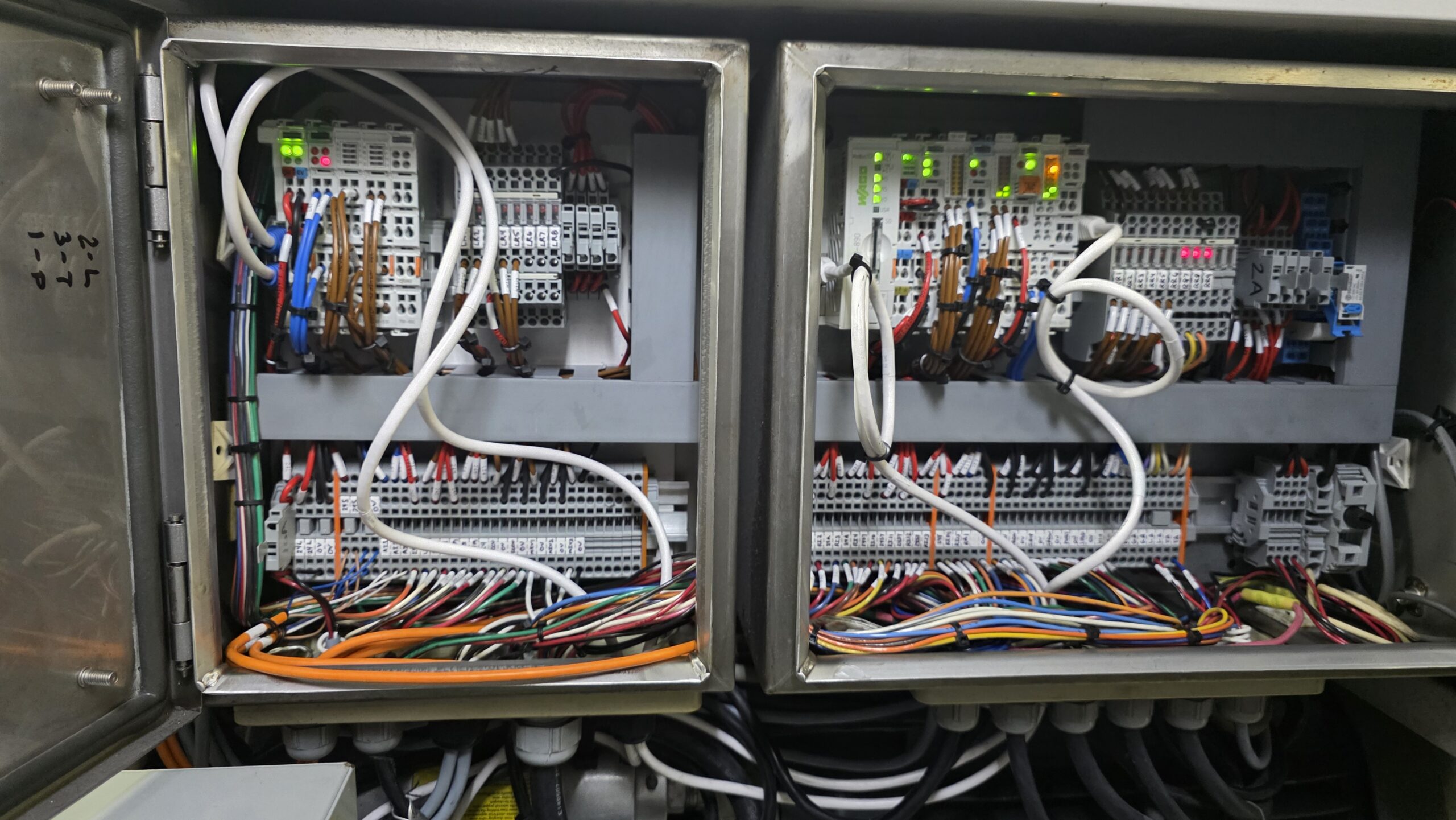
A Beijer HMI yacht job is the glass. Captains do not call asking for a prettier mimic. They call because the night watch cannot tell whether a passerelle pin is home, because the OEM panel is a hex code and a beep, because the last operator screen cracked and there is no spare in the locker. The CPU can be healthy. The plant can be sitting in a perfectly legal state. None of that helps the bosun if the page is a programmer's memory map.
We put Beijer on the door of the panel, or on a local station the crew already walks to. Fort Lauderdale and Newport, because that is where the boats already sit. Custom yacht controls for build-outs and retrofits. Our team of electrical engineers can get it done. Guest lighting can wait. The watch needs a screen they can press at 0200.
What a Beijer HMI yacht screen has to show the watch
Three pages if you write them honestly. Overview: the functions this panel actually runs, in the state they are in, not the state you commanded ten seconds ago. Alarm list in English a bosun can walk to. One equipment page with commanded versus confirmed for each motion. That is the whole pitch. A GA drawing as wallpaper is how you teach people to ignore the glass.
A door page is a useful example, then we are done with doors. Open, closed, traveling. If the mimic only has two lamps, it is lying about the third. A passerelle page is the same shape: stowed, deployed, traveling, pin. Press it. See the truth. Move on. Treat the HMI as the place the watch looks when those things are the job tonight.
Alarms in English. Not a hex. Not a German abbreviation from a hydraulic OEM that aged out. Travel timeout. Pin mismatch. Low pack pressure. Limit that never arrived. Motion commanded against a lock. A bosun should be able to read the line, go to the trunk or the coaming, and do something. If they have to call the engineer out of a tank to decode the banner, the page failed.
Permissions are boring and they keep people from doing something stupid. Deck should stow a passerelle without hunting guest graphics. Engineering should see analog values and the last alarm without flipping through interior scenes. Interior should not have a tile that deploys a boarding bridge. One Beijer family can still be several views. Ask for the split in the spec, not as a favor after commissioning.
Beijer X2 yacht pages a bosun can run at 0200
The X2 is the unit we actually put in. Color touchscreen. Pages you can design for a watch, not a trade-show booth. The named example we will put in writing is the 46m Trinity Yachts (2002) hydraulic control refit. Koopnautic / Quantum aged out. Tanks and valves stayed. WAGO PFC200 as the CPU. Beijer X2 as the face. IFM on level, pressure, and oil temperature. That job is a hydraulic story. It is also the Beijer-on-the-panel example: a 10-inch screen the crew used for windlass, crane, fins, and alarms that said what was wrong. We are not going to invent a second nameplate.
Sit in front of the glass and try to do the job. Find the last alarm. Tell whether a valve was commanded and whether it confirmed. Change a setpoint you are allowed to change. Fail to change one you are not. If you need the programmer standing behind you, the page set is wrong. If every function is a unique icon with no text, the night watch will guess. Guessing on a hydraulic auxiliary is how people get hurt.
Twenty minutes of walkthrough, not a binder. Overview. Alarm list. The one or two equipment pages they will actually open. If a page needs a speech, the page is wrong. The night watch will definately go back to the bypass, and then you have glass nobody trusts. Training is short when the language matches how the boat is used.
Hold-to-run belongs on a local that can see the plank, the leaf, or the hook. Status belongs on the wheelhouse or ECR view. Mixing those without a master mode is how you get a function hunting while a bosun is standing under it. Ask where the second X2 lives if the boat actually runs from two places. Wheelhouse and ECR. Sometimes a local at the boarding station the crew already uses. Do not discover that on sea trial. Caleb (Head Systems Engineer) will write the pages. He still needs the watch to stand in front of them in the yard and say which tile they would press at two in the morning.
Commanded versus confirmed on a yacht control screen
This is the line that separates a working yacht control screen from a pretty one. Commanded is what the PLC asked for. Confirmed is what the field actually did. A green stowed that is only the output coil is decoration. A failed output should not paint success. The watch has been burned by that lie before. They will not forgive it twice.
On a hydraulic auxiliary: pump called, pressure arrived. Valve commanded, limit made. On a watertight leaf: close issued, door home, dogs if the leaf uses them. On a passerelle: pin out commanded, pin out confirmed, then rotate. The screen has to show both columns, or the watch is flying on hope. IFM earns its keep here because the confirm is a real sensor, not a gauge in a trunk nobody opens until the oil is already dark.
Timeouts belong on that page. If the confirm never comes, the HMI says so in English and the logic stops. A silent retry loop is how you teach people to ignore glass. Traveling is a third state. If your screen only has two lamps, it is lying about the middle. Indication has to be independent of the command. That sentence should be in the spec, not in a toolbox talk after the first mismatch.
The night engineer should see the last commanded motion, the last confirmation, and whether the mismatch is still active. That is diagnosis. Pretty pipework graphics are not. Priority on the alarm list matters the same way. Stop-the-job versus watch-it. Low oil is not the same banner as a sequence that did not complete. Rank those with the chief, in writing, before anyone draws an icon.
Yacht HMI replacement when the OEM glass is dead
A yacht HMI replacement is usually a glass-and-pages job sitting on plant that still works. The OEM operator panel aged out. Proprietary. No spare. A specialist in another time zone who might call back Thursday. The CPU behind it might be just as dead, and then you are in a control refit. Sometimes the CPU is still a PLC you can support and the screen is the part you cannot buy. Ask which, in the first meeting, before anyone quotes a room full of new steel.
Do not buy another sealed yacht-only panel that will age the same way. Beijer is catalog hardware. Current production. A smashed screen during a Med season should be a courier problem, not a redesign. Project file. Panel image. Spare unit on the boat. Same cutout if the glass lives in a door. Same family if you ever have to borrow a unit off a sister panel in the shop.
What comes off is the tired mimic, the membrane that no longer clicks, the touchscreen that drifted until you had to stab the corner. The plant stays. The field devices that still tell the truth stay. The logic stays if the PLC is still a PLC. Pages the watch can read go on. If someone is quoting a full mechanical rip-out because the operator panel died, ask why the glass cannot be the scope.
The CPU and the rail are a different conversation. We already wrote why a WAGO yacht PLC control panel still has spares. Read that if you are arguing the brain. This post is the face. Logic in the PLC. Display on the HMI. Hold that line when a vendor tries to hide the sequence inside the touchscreen so the next cracked glass takes the plant with it.
HMI yacht PLC: what still runs if a marine HMI yacht screen dies
If the Beijer goes dark, the plant should sit in a defined state, not a random one. Captains should ask that in the first meeting. If the screen fails, what still runs, and what is locked out on purpose. A package that only lives on a touchscreen is one cracked glass away from a problem. Local hold-to-run that is a real circuit, not a soft button. Indication that survives. Interlocks that still interlock.
A passerelle should not hunt because the last page left a bit set. A door should not travel because a ghost touch hit close-all. A hydraulic auxiliary should not keep a pump called because the acknowledge never made it back. Those are logic questions. The glass is how you see the answer. When the glass is gone, the answer has to already be in the PLC.
Power-loss is a cousin of HMI-dark. Main dies. Screen goes black. What did the plant do. Stay. Complete a motion already in progress. Go limp. Those are three different boats. The watch has to know which one they have before the drill. Transitional indication so the mimic does not vanish in the one moment you need it. We will not pretend a logo on a datasheet is your class certificate. Lloyd's, DNV, and Bureau Veritas each ask in their own voice. Your job is a package that can answer those questions with a test.
Caleb will care whether those fail states are actually in the logic, not a hope that the screen stays up. Adam (Electrical Engineer) will care whether the HMI feed is fused so a dead glass does not take the CPU with it. Kyle (Operations) will care whether the spare is on the boat before the Fort Lauderdale window closes, or the shorter Newport one you cannot slide.
Spare Beijer operator panel yacht hardware on the boat
A Beijer operator panel yacht spare belongs in a locker you can walk to, not in a vendor warehouse two time zones away. Write the part number on the drawing. Write which locker. A Fort Lauderdale shop is a useful backup. The boat is the right place for the part that kills a Saturday. Newport the same. If the only spare lives at a vendor who is closed when you are in a seaway, you have a brochure.
Same family as the unit that is fitted. Same size if it lives in a door cutout. The project file on the boat, or at least on a stick the chief can find without a login. A cracked X2 during charter week is a swap if you planned it. It is a season if you did not. Put the image next to the spare. A blank panel with no file is a paperweight.
Commissioning the glass is function-based. Each page. Each permission. Alarms you actually expect, generated on purpose in the yard so the watch sees the English before they need it at sea. Commanded versus confirmed with a limit lifted, so you see the mismatch while it is safe. Other trades will still be in the space. Plan as if they will lift a feedback pair the night before sea trial. Sometimes they will. Newport in season has less calendar to absorb that.
Bring a short list to the meeting. You do not need to become a graphics designer. You do need answers a chief can live with after the yard leaves.
- Pages the watch will actually open: overview, alarm list in English, commanded versus confirmed on each motion
- Who is allowed to press what (deck, engineering, interior), and where the second screen lives if the boat runs from two places
- What still runs if the HMI dies, what is locked out on purpose, and what power-loss does to indication
- Spare Beijer on the boat, part number, project file, and whether that unit is still manufactured
- Who the crew calls after the yard, by name, not a generic inbox
If you want that conversation, send the existing operator panel photo, a page list if one exists, and the crew's list of which tiles they no longer trust. A note to kyle@yachtautomations.com is enough to start. Caleb will tell you whether the pages belong on an X2 the watch can still buy. Adam will tell you whether the glass is even the job. Kyle will tell you whether the Fort Lauderdale window, or the shorter Newport one, can take it. We would rather keep a supportable OEM screen than ship a pretty mimic the night watch cannot read. The watch gets glass they can press, a spare they can swap, and a plant that still sits in a defined state when the HMI goes dark.